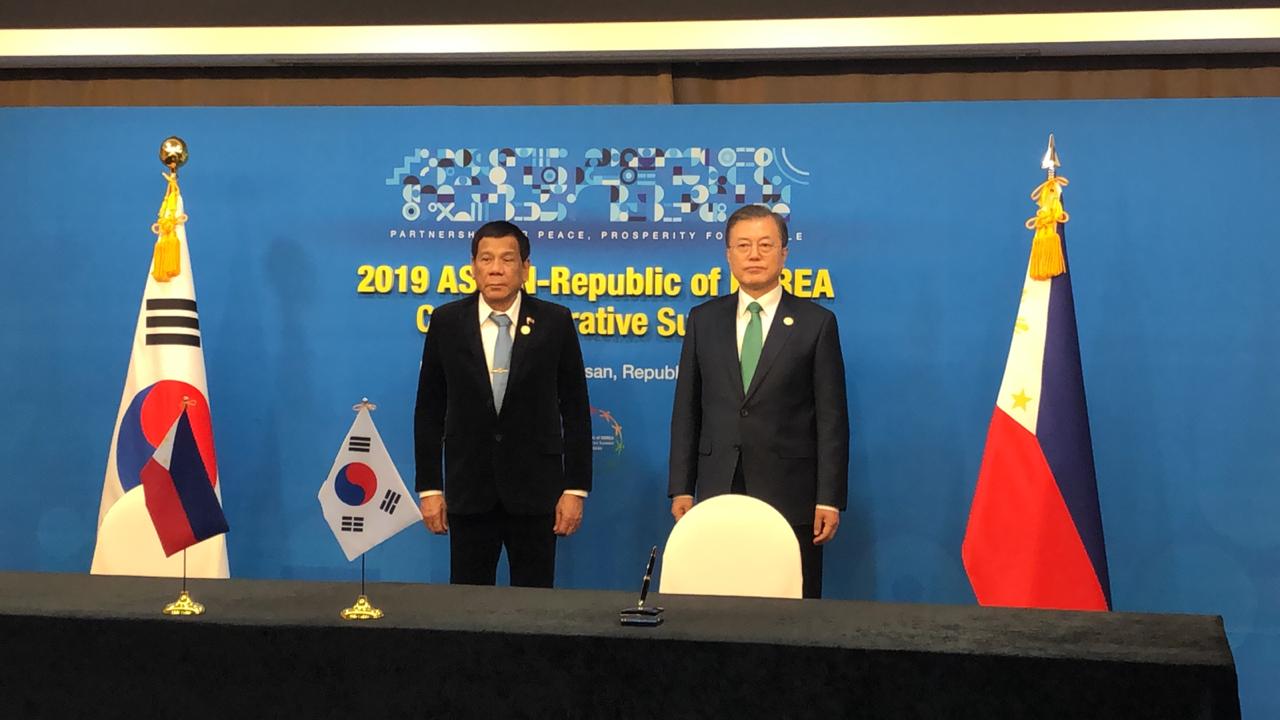
South Korea's Moon says the Philippines is 'future of Asean' Pathricia Ann Roxas Inquirer.net 25 November 2019 BUSAN, South Korea — South Korean President Moon Jae-in has described the Philippines as “the future of Asean” as President Rodrigo Duterte met him in a bilateral meeting here Monday.
“The Philippines is the future of Asean as it continues to achieve an impressive growth rate of 6 percent each year thanks to your outstanding leadership,” Moon said in his opening speech.
“Through our meeting today I hope to strengthen my friendship with you and extend our bilateral cooperation to contribute further to the development of Asean,” he added.
For his part, Duterte expressed gratitude to the Korean government for their 70 years of cooperation in various areas like trade, industry, agriculture, infrastructure, and technology.
Duterte said the two nations “took diverging paths and fortunes,” with South Korea rising “as one of Asia’s economic and technological powerhouse.”
“Ours faltered, but with perseverance, the Philippines has since recovered and is now an emerging economy,” Duterte said.
He further noted that South Korea was the Philippines’ 4th largest trading partner in 2018 as well as a major source of foreign and direct investments.
“I assure you that the Philippines will find common cause and purpose with the Republic of Korea towards enhancing our bilateral engagement and promoting peace and stability in your region,” Duterte promised.
This bilateral meeting is anticipated to result in the two leaders’ signing of agreements on education, tourism, social security, and fisheries.
Philippines a top foreign investment destination with 613% surge in approved investments PR Newswire Asia 22 November 2019
BOI Figures Show +600% Rise by September 2019 with South Korea Topping Foreign Investments from East Asia
MANILA, Philippines, Nov. 22, 2019 /PRNewswire/ -- New data has unveiled a surge in BOI approved foreign investments which are expected to flow into the Philippines over the next 2-3 years. These initiatives have made the Philippines a top investment destination, largely attributable to its continuing digital transformation and combined information and communications technology (ICT) and infrastructure efforts. Approved foreign investments by the end of September 2019 reached USD4.7 billion, a 613% rise from USD659 million in the same period in 2018, BOI figures show. Investment approvals as of September 2019 totaled USD15 billion, a 105% jump from USD7.31 billion in the same period of the previous year. The tourism sector also continues to rise with USD186.3 million worth of hotel and accommodation projects, while manufacturing is seeing consistent growth of USD1.24 billion of approvals, a 190% increase on last year. Trade and Industry Secretary and BOI chairman Ramon M. Lopez applauded the results, commenting: "This data shows that big-ticket projects are now rolling in, proving the strength and resilience of the Philippines economy in attracting foreign investors despite the global slowdown. "The results are a testament to the Philippines as a great place for foreign investment where business can thrive." Explore investment opportunities in the Philippines Investors can explore business opportunities in the Philippines at Invest ASEAN 2019 in Busan, South Korea on November 25-26 where the BOI will represent the country considered by the US News and World Report in 2018 as the best to invest in. At this event, BOI will showcase opportunities in specific priority sectors: manufacturing, specifically electric vehicle and auto parts; infrastructure and construction; and tourism "This growth, together with a suite of incentives such as tax holidays and exemptions from duties on imported spare parts makes the Philippines an enviable investment destination and one-stop-shop for business within Asia and beyond," added Lopez.
Investments in Philippines double up in January -September 2019, hitting 15.14 bln dollars Xinhuanet.com 08 November 2019
MANILA, Nov. 8 (Xinhua) -- The Philippine Board of Investments (BOI) said on Friday it has recorded cumulative investments worth 764.7 billion pesos (roughly 15.14 U.S. dollars) as of September 2019, a 105 percent increase from 327.9 billion pesos (roughly 6.50 billion U.S. dollars) approved in the same period of 2018.
"The sustained high growth of investments is a proof of the business sector's strong confidence in both the Philippines' economic fundamentals as further shown by the acceleration of the third-quarter gross domestic product (GDP) growth to 6.2 percent and the reform agenda of President Rodrigo Duterte," Philippine Trade Secretary and BOI Chairman Ramon Lopez said.
The BOI said approved investments from domestic sources topped 524.9 billion pesos (10.40 billion U.S. dollars), a 54.7 percent increase from 339.3 billion pesos (roughly 6.7 billion U.S. dollars) in the same period in 2018.
On the other hand, the BOI said approved projects by foreign investors amounted to 239.9 billion pesos (roughly 4.8 billion U.S. dollars) or 613 percent increase from just 33.6 billion pesos (roughly 665.7 million U.S. dollars) a year ago.
According to the BOI, Singapore continues to set the pace among all foreign entities with 170 billion pesos (roughly 3.37 billion U.S. dollars) in the capital. It added that South Korea is now second with 34.1 billion pesos (roughly 675.62 million U.S. dollars), while The Netherlands places third with 9.2 billion pesos (roughly 182.3 million U.S. dollars).
According to the BOI, all projects once operational will generate employment of 41,862, which is 38.5 percent higher than last year's figure of 30,218.
"We are particularly pleased to highlight that the share of foreign investments in BOI projects have increased from just eight percent during January to September 2018, to already 31.4 percent this year," Lopez added.
This is expected to continue as Lopez noted that Duterte's policy of furthering relations with non-traditional partners has been yielding results.
Philippine Trade Undersecretary and BOI Managing Head Ceferino Rodolfo said investments from the information and communications technology (ICT) and power sectors accounted for 85 percent of the total figure or 652.9 billion pesos (roughly 12.94 billion U.S. dollars).
"This massive infrastructure buildup for more power and connectivity across the archipelago is critical towards addressing binding constraints to the Philippines' competitiveness," he added.
China has the most atheists, Indonesia and Philippines the most believers
Tanutam Thawan| The Thaiger.com
19 October 2019
“According to the survey there is a connection between religiosity, beliefs and socio-demographic characteristics like age, income and education level.”
China is the least believing country in the world but belief in a God gets 100% mention in countries like Indonesia, Bangladesh and Philippines, according to the survey by Gallup International.
According to the survey exploring religious tendencies of 66,000 people in 68 countries across the world, 62 per cent of people in the world define themselves as religious, 74% of people globally believe we have a ‘soul’ and 71% believe in a God. Another 56% believe in heaven, 54% in life after death and 49% in hell.
China has the highest percentage of atheists in the world with 67% not believing in any religion. Every seven out ten people are atheists, more than double than any other country. 23% consider themselves as non-religious. Less than 10% identify themselves as religious in China.
China’s atheist percentage is followed by Japan, a long way behind in second place at 29%, Slovenia (28%) and Chech Republic (25%). Despite rapid industrialisation and urbanisation religion has stayed relevant in the South Korean region with only 23% identifying as atheist.
European countries like Belgium (21 %), France (21%) , Sweden (18%) and Iceland (17%) also have a large percentage of believing population.
Bangladesh, Indonesia and Philippines are the most believing countries with entire population claiming to believe in God, soul, hell and heaven. Thailand and Pakistan have 99% believing population, followed by India, Vietnam and Mongolia.
The survey shows that the levels of religiosity diminish as income and education levels increase. While 66% of people with low income affirm to be religious, this percentage drops to 50% among people with higher incomes. The same trend is verified in relation to education levels: 83% of people with lower education level are religious against 49% of higher level.
According to the survey there is a connection between religiosity, beliefs and socio-demographic characteristics like age, income and education level. As education and income levels grow higher, religiosity levels tend to go down. Also, the expression of different beliefs is higher among young people.
The level of education has a considerable influence on the perception of religion by the society. Women and young children show higher percentage for spiritual forces.
Maja Salvador lone Filipino winner at Asia Contents Awards in Busan
Manila Standard 08 October 2019 Actress and Star Magic artist Maja Salavador bagged the first-ever Best Actress award for drama in the 1st Asia Contents Awards held in Busan, South Korea, for her portrayal of the lead character in the hit TV series, Wildflower. Maja, who is also the lone winner from the Philippines, portrayed the role of Lily Cruz who changed her identity to Ivy Aguas, a feisty young woman out to avenge her parents’ death and fight the oppression brought by the cruel and corrupt Adriente clan. The actress and her show were the only nominees from the Philippines as Wildflower was also nominated in the Best Drama category.
Wildflower competed with other outstanding Asian TV series from South Korea, China, Japan, Hong Kong, Taiwan, Indonesia, Malaysia, Singapore, Thailand, Brunei, Vietnam, Laos, Myanmar, and Cambodia.
The 1st Asia Contents Awards recognized the region’s finest TV dramas that were produced in the last five years. It is organized by the renowned film festival Busan International Film Festival and Asian Film Market, an annual film market in South Korea.
Wildflower has begun airing in three French-speaking countries, including New Caledonia, Polynesia, and Reunion Islands, with the recent partnership of ABS-CBN with Ampersand fiction, a French content distributor and will soon air in Madagascar this October with ABS-CBN’s deal with Startimes.
SB-19: Pinoy band with K-pop sound is winning fame
- and perhaps making history
In this To be You exclusive, the boys with the humble beginnings and arduous four-year training finally ‘go up’
Anton Segismundo
Philippine Daily Inquirer
September 21, 2019
All I knew about SB19 before meeting them was that they’re an all-Filipino group with a K-pop sound rapidly building momentum on social media, thanks to their fresh sound, unquestionable talent, and good looks.
I arrived in an empty office of ShowBT Philippines Corp., the events/concerts production company that handles the group. This is where they hold rehearsals. I came a bit earlier than the appointed time and was greeted by a tall guy who immediately apologized, “I’m so sorry, our manager’s not yet here.”
He then asked, “Would you like me to make you some coffee or get you some water?”
He introduced himself as Stell, the main vocalist of SB19. He introduced me to the group’s other members who were very welcoming and even apologetic because they said their studio was messy.
Turned out they came from a gig the previous night and decided to sleep in the studio—on the floor—because they couldn’t commute home due to the horrible traffic. They also didn’t want to be late for our interview and shoot.
Origins
Before auditioning for ShowBT, Justin, the youngest member, and Ken, the main dancer, were students. Josh, the lead rapper, and Stell were with an established dance group, and Sejun, the leader, was working as a data analyst. (By the way, all go by stage names.)
While each member had a different back story, all five had one thing in common: the dream to be a performer. With that goal in mind, none of them hesitated to join the audition held by ShowBT to form a pop group.
Stell recalled the tedious process. “It all started with the audition. When we got in, we went through grueling training sessions. Every week had an evaluation, so trainees were scrapped off the team weekly—it would happen spontaneously sometimes. We’d also have weekly tasks to determine who’d stay and who’d go.”
At the end of the “training camp,” there were just five of them. SB19 was born.
KenSejun said, “SB stands for sound break because the main goal of the group is to break into the music scene of the Philippines with our new and fresh sound. 19 represents the youthful generation and the combination of the country codes of the Philippines and Korea. The Philippines’ country code is 63 and Korea’s is 82; so 6+3+8+2=19.”
Four-year process
Before their debut, members of SB19 had to hone their talent and perfect their craft for four years. The period, according to Josh, saw the group facing many struggles.
“Coming in, we knew we’d have to give up a lot mentally and physically,” Josh recalled. “We had financial problems and family problems—sometimes our own parents couldn’t even support us anymore because four years without a big break was a difficult thing to accept.”
Contrary to popular belief, the group was not trained in Korea. They were trained right here by a combination of Filipino and Korean mentors. When they did go to Korea, it was to record their songs and prove they had what it takes.
In Korea, SB19 performed with the likes of Psy, Up10tion, and GFriend in arenas with crowds of more than 20,000. The reception by the Korean crowds was great—the guys believed they proved their talent.
According to Stell, the group practices singing and dancing each number they composed at least 30 times a day—the aim is to practice each song at least 1,000 times. Only after reaching that 1,000th mark do they release it.
Online reception
This perfectionist mindset is probably why their online content is full of positivity. I have yet to see online haters/bashers of the group.
Sejun
Stell
“It feels so good that Filipinos appreciate our music. We all know that Filipinos have been so used to rock bands and ballads so we were shocked by the positive response,”said Ken.
This response was apparent during their performance the night before our interview. “Yesterday was the most memorable show we had,” said Sejun. “There were a lot of people and they were really singing along with us. They were singing so loud we couldn’t even hear our music anymore. I wanted to cry onstage.
Nakakakilig.”
They also received praise from a renowned Korean producer they worked with when they recorded their single, “Go Up.”
Stell recalled how this producer, who has worked with other famous “idol” groups in Korea, told them, “This is the first time I’ve worked with a Filipino idol group and I never expected Filipinos to be this good.”
I ‘Go Up’ for…
Asked who they “go up” for, each member gave his own unique answer. Justin goes up for himself first so that he can start helping others. Ken goes up for his goals, while Stell said he goes up for his family because of their unending support.
Justin
Josh revealed an inspiring backstory. “I’ve been through a lot in my life. My childhood was rough—I never got to meet my father, I finished only elementary and I just pursued work for myself. I was really independent—and so I go up for myself.”
Finally, Sejun said, “All my life I felt the need to prove myself to everyone. I’ve always wanted to be an artist, but I never had the chance to take the path because of various responsibilities. I go up for me, myself, my family, and everyone who believes in me.”
A promise
For all those who believe in these young men, the guys are beyond thankful. Said Justin, “To all our supporters, to all those who appreciate us, we would like to say thank you. We don’t know how else we can repay you for your support other than by working harder, practicing harder, and giving our all so that we’ll be able to give you a satisfying performance.”
I left the dance studio with the boys on the floor, bundled together, playing Nintendo Switch with pure joy on their faces. They are truly a group of humble and genuine artists. If they keep this up, “going up” won’t be a problem—they will surely reach the top (if they haven’t already) in no time. —CONTRIBUTED