Showing posts with label UNESCO. Show all posts

Friday, November 1, 2019

...the PH world's creative cities

Cebu joins Baguio on UNESCO's list of world's 246 'creative cities'


Jenina P. IbaƱez
Business World 
01 November 2019

CEBU CITY has been counted among the 246 UNESCO Creative Cities around the world, becoming the second Philippine city after Baguio to bag the recognition.
a view of a city
United Nations Educational, Scientific and Cultural Organization (UNESCO) Director-General Audrey Azoulay on Wednesday declared Cebu as one of the 66 new cities to be included on the list of cities that push creativity and innovation as major factors in urban development.
The Department of Trade and Industry (DTI) said in a statement on Thursday that creative cities with varied income levels and populations support sustainable development actions that directly benefit communities at urban level.
Cebu was designated a creative city of design, one of seven UNESCO categories that also include gastronomy, literature, film, music, crafts and folk art, and media arts.
Baguio City was included in the crafts and folk arts category in 2017.
“All over the world, these cities, each in its way, make culture the pillar, not an accessory, of their strategy,” Ms. Azoulay was quoted as saying. “This favors political and social innovation and is particularly important for the young generations.”
Trade and Industry Secretary Ramon M. Lopez in a mobile phone message said that the designation raises the city’s image. “Cebu City as a UNESCO Creative City of Design raises the image of the city and becomes a seal of approval and recognition in the global stage. Therefore, it is a great testimony to the city and the country of our design talents and skills and help in the positive branding of the city and country.”
He added that Cebu and DTI will work to maintain the recognition by nurturing the city’s design ecosystem “from the point of view of enterprise and investment development, talent development and education, and public awareness.”
MATIQ Hub board member Butch Carungay, as a private consultant, led Cebu’s application to UNESCO with support from local government and the DTI. They highlighted contributions of creativity to Cebu City’s economy by tracking business registrations of creative industries and sifting through export databases.
MATIQ Hub is a multi-disciplinary enabling space for creativity that focuses on indigenous materials, art, technology and innovation.
Mr. Carungay said in a telephone interview that Cebu artists export furniture and fashion products, and have strong graphics and animations industries.
“We’re a very small island with very little resources, so we have a resilient industry of being able to maximize what little we have to become a really innovative city,” he said.
He said that he hopes the UNESCO designation will kickstart more projects in the city.
“When we started this process, Cebu has a lot of gaps in hardware. We don’t have the proper infrastructure,” he said.
Continued growth of the creative industry, Mr. Carungay said, would require more hardware: creative venues for artists to congregate and create commercial projects. He also hopes to improve what he calls the creative software of the city: embedding design thinking into education and the workplace.
After joining the network, creative cities are tasked to strengthen the creation and distribution of cultural activities, goods, and services. They commit to developing creativity hubs, improving access to cultural life for vulnerable groups, and integrating creativity into sustainable development plans.
Applicants were required to demonstrate their commitment and capacity to contribute to these objectives by demonstrating a development strategy, creative assets and facilities, and the capacity to involve professional and civil society, among others.
Socioeconomic Planning Secretary Ernesto M. Pernia in a mobile phone message expressed optimism for more Philippine cities to be included in the list. “That’s great — an incentive for Cebu to become even more creative, as well as for other cities to aspire for such recognition,” he said.
ZANY JADRAQUE/UNSPLASH

Thursday, September 19, 2019

...the winning lensman in Russia

Filipino lensman bags second place in int’l photo contest


Gabriela Baron
Manila Bulletin
17 September 2019


A Filipino photojournalist bagged second place in the Andrei Stenin International Press Photo Contest in the Top News, Singles category in Moscow, Russia recently. 

Basilio Sepe's "Baywatch". (Photo courtesy of Photojournalists' Center of the Philippines, Inc. / MANILA BULLETIN)
Basilio Sepe's "Baywatch" (Photo courtesy of Photojournalists' center of the Philippines, inc./Manila Bulletin

Basilio Sepe, a member of the Photojournalists’ Center of the Philippines (PCP), won the award with his photo capturing informal settlers scavenging recyclable materials in Navotas after Typhoon Karding hit in August 2018.

The photo contest was launched by Rossiya Segodnya under Russia Commission for the United Nations Educational, Scientific and Cultural Organization (UNESCO) to support young photographers and to popularize the challenges of modern photojournalism.

Photographers from 80 countries on five continents participated in the photo contest with over 6,000 works submitted.

The 24-year old photojournalist has previously won the IPA (International Photography Awards) Filipino “Photographer of the Year” last year for his work on the Philippines war on drugs.

Sepe was the former chief photographer of the Varsitarian, the official student publication of University of Santo Tomas (UST), and an alumnus of the Angkor Photo Workshop 2016.

He is currently an independent photographer based in Manila and has done multimedia works for local and international news agency.

Sunday, June 15, 2014

...the capital of fun

Manila depicted as ‘capital of fun’


Manila, the second largest city and capital of the Philippines, is the subject of the newest “It’s more Fun in the Philippines” campaign.


The thirty-three second video clip released by the Department of Tourism (DOT) defined Manila as the capital of fun. The video showcased several remarkable places in Manila such as the historical Luneta Park, Intramuros as a UNESCO World Heritage Site, and Makati which is the financial capital of the Philippines.

In its website, DOT said Makati is the perfect place to indulge in world-class cuisine while Intramuros is the best place for a cultural escapade.

The DOT said the new advertisement “shows Manila as the city that has everything under the sun.”

The country's tourism slogan “It’s more fun in the Philippines” was launched in 2012 to attract visitors to the country. The campaign hopes to enjoin the whole country in creating positive buzz around this tagline. The campaign has earlier featured Davao City and Boracay. (Mary Rose A. Hogaza)

Saturday, November 23, 2013

...the PH best Islands

The Philippines: a guide to the best islands


Six of the country's 7,000-plus islands were devastated by Typhoon Haiyan; many of the others badly need tourists to return. Local writer Aya Lowe picks the best places to go.
 
 
Aya Lowe
theguardian.com (United Kingdom)              


Young surfers at Cloud Nine surf point, Siargao, Philippines
Two young surfers carrying boards at Cloud Nine surf point, Siargao. Photograph: Alamy
 
For a country with thousands of idyllic islands, plus world-class surfing and diving, the Philippines is a relatively undiscovered travel destination. Tourism is crucial to the country's economy, accounting for eight per cent of its GDP, but compare the UK visitor numbers – 120,000 in 2012 – to those of Thailand (800,000 per year) and you get some idea of just how off the radar this vast archipelago is.

This month, of course, the country is firmly on the world's radar – for all the wrong reasons. Typhoon Haiyan caused wide spread destruction across the provinces of Leyte and eastern Samar on the mid-eastern side of the Philippines and some parts of Palawan and Cebu on the mid-western side. But while the areas in the path of the typhoon were devastated, much of the country was not damaged.

The storm caused havoc on six of the country's 7,107 islands, so most resorts and tourists activities are open and fully functional, and those that were hit are quickly getting back on their feet in the run up to December and January, two of their busiest months of the year.

The tourist board and tour operators are reassuring visitors that the country is not only safe, but in desperate need of visitors to bring a vital boost to the economy. Those who go will receive a very warm welcome. So, how do you choose which of those 7,000-plus islands to visit? Here's our guide to 10 islands, each offering something different.

1. Chill out in El Nido, Palawan

Bacuit Bay, Palawan, Philippines Bacuit Bay, Palawan, Philippines. Photograph: Alamy
 
This jungle beach town on the northern tip of Palawan hasn't changed much since before Spanish colonisation and has been cited as Alex Garland's The Beach. Explore the many islets of the nearby Bacuit archipelago on a boat-hopping tour, where the water so clear you can see the fish darting in between coral at 15 metres deep. Prices range from around £17-£20 per day for a tour and that usually includes lunch. There is grilled seafood is in abundance across the island.

Palawan was one of the islands in the path of Typhoon Haiyan, however it was only the city of Coron and the nearby island communities that were hit. El Nido has not suffered any damage and the surrounding coral reefs are intact, with only very shallow ones sustaining damage.

Where to stay: For beachfront living, Rainforest Beach Hotel offers rooms from £31 per night in high season. For a high-quality budget option, try Residencia Katrina , five minutes from the beach (from £21 per night).

How to get there: Local airlines fly directly to Palawan's capital, Puerto Princesa. From the city's main bus terminal, you can take a seven-hour Roll-On Roll-Off (RORO) bus to El Nido for £7, one way.

2. Shake your tail feather in Boracay

White Beach, Boracay, Philippines White Beach, Boracay Island, is often voted the best beach in Asia. Photograph: John Harper/Corbis


With endless beaches of powdery-white sand, long happy hours, abundance of restaurants and hotels to suit all budgets, and plenty of watersports, Boracay is the party island.

It has 12 beaches, the most popular being White beach and Bulabog. The island is divided up into "boat stations", which are used a reference points. Station One in the north is known for its high-end resorts and tranquillity; station two is the liveliest part, and station three is where all the budget accommodation can be found. While many locals look back longingly at good old days in the 70s before the hotels and restaurants started springing up, Boracay is still a Phuket in its infancy.

There was some storm damage to the island. Electricity still remains a problem for many parts of the island, but most hotels are up and running with generators.

Where to stay: Frendz Resort Boracay has one of the best beach locations out of all the midrange options (£50 for a beachside bungalow, sleeping four). Nigi Nigi Nu Noos has Balinese-style bamboo cottages furnished with handicrafts and wooden sculptures. Rooms are £70 per night.

How to get there: You can fly via Kalibo and then take a two-hour bus ride for £4, then a 15-minute ferry.

3. See a UNESCO World Heritage sight in Banaue, North Luzon

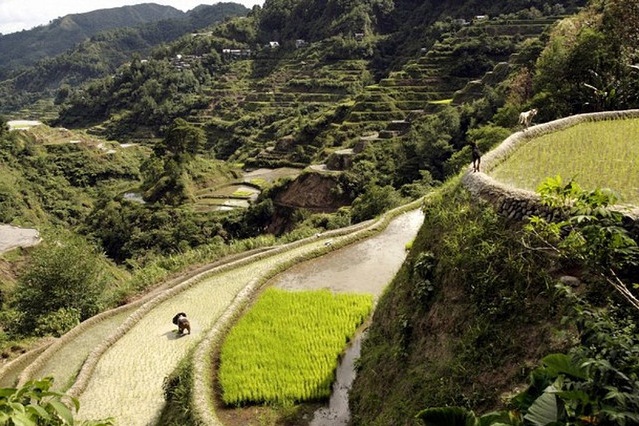
Rice terraces, northern Luzon, Philippines Amazing two thousand year old rice terraces, Banaue, northern Luzon. Photograph: Alamy
 
North Luzon, the biggest island of the Philippines, is a land of misty mountains, where pines replace palm trees. Head to Banaue and Batad to admire the 2,000-year-old rice terraces etched along plunging ravines. The 20,000km UNESCO-listed terraces still provide a livelihood for the various tribal groups that continue to live in relative isolation in the mountains. Treks along the rice terraces to various villages and waterfalls can be organised through the Banaue Tourist Information Center. Expect to pay around £10 for a guide for a whole day.

Where to stay: If you want to wake up to a view of the famous rice terraces, head to Batad, where a number of low-cost, basic guest houses line the mountains. Try Ramon's Homestay, where the owners are a great source of information about the local culture. It's £2.80 for a regular room or £3.50 to stay in a traditional Ifugao (local tribe) hut.

How to get there: North Luzon is best reached by bus, but be prepared for a long journey. Buses leave regularly from Manila and take nine hours to get to Banaue, costing £7.

4. See the curious in Bohol

Chocolate Hills Natural, Bohol, Philippines
Asia
Chocolate Hills, Bohol Island. Photograph: Per-Andre Hoffman/Alamy
 
Located just off Cebu, Bohol's most famous attraction is the surreal Chocolate Hills: over 1,500 mounds formed by coral deposits sculpted by a millennia of erosion. Depending on the season, they will either be green or brown. The island's famous resident is the camera-shy tarsier, the world's smallest monkey. Visit them in their protected enclosure at the Philippines Tarsier Foundation. Don't visit them in the cages kept along the river; they are mistreated and don't live long there. Either hire a motorbike or book a tour from a local company, such as Bohol Travel Tours, for around £35 with car, guide and lunch.

In October this year, the island suffered from a 7.2-magnitude earthquake, destroying many houses. Two weeks afterwards, Bohol was back on its feet, bringing in tourists as normal. The island was also hit by Typhoon Haiyan, but sustained little damage to its infrastructure. Tour operators and hotels remain fully open. The main issue being tackled by the island's authority is limited power supply, which is slowly but surely getting fixed.

Where to stay:Alumbung Bohol is a comfortable resort of beachside bungalows on popular Panglao island (from £20 per night). For something different head to Bohol Bee Farm , an organic vegetable and bee farm with rooms on Panglao, from £28 to £70 per person.

How to get there: Local airlines, including Cebu Pacific, fly to Tagbilaran airport from Manila, or you can catch a two-hour ferry from Cebu to Bohol (£7, one way).

5. Go surfing in Siargao

Facing the Pacific Ocean, just north of the island of Mindanao, is Siargao, one of the Philippines' surf centres. The town sees a steady stream of dedicated surfers who arrive to challenge themselves on the island's famous Cloud 9 reef break. The small beachside town hosts a number of international surfing competition, which make it a busy during surf season, but completely dead when the waves are down.

Novices can hire trainers, who you can find on the beach, for around £7 per hour, or you can book a package from a surf hotel, such as Kermit Surf Resort , which has a package for £394 per person per week, including accommodation, transfers and one-to-one surf lessons.

Where to stay: The no-frills, £5-a-night Bamboo Garden is popular among backpackers. Surfers tend to stay in Kermit Surf Resort (bungalows are £11 per night).

How to get there: There are direct flights to Siargao Island. Siargao airport is 45 minutes away from General Luna, the location of the popular Cloud 9 beach.

6. Get off the beaten track in Camiguin Island

Camiguin Island, Philippines Camiguin Island, Philippines. Photograph: Stuart Dee/Getty Images
 
This pear-shaped volcanic island, just off the northern tip of Mindanao, is often bypassed because of various Islamist uprisings that have been reported on Mindanoa. However, Camiguin itself has never had any incidents and those who make the effort to travel there are rewarded with an island barely touched by tourism. For such a small landmass, this tiny island packs quite a punch, its 29,187 hectares including seven volcanoes. It also offers good diving through an eerie sunken cemetery, waterfalls, a lagoon, and hot and cold springs. All of these can be reached easily by foot, or hire a motorbike (£11 a day with a driver,£7 without).

Where to stay: If you want to splurge, go to Bahay Bakasyunan sa Camiguin for £50 per night. If you are on a budget, try the Enigmata Tree House homestay at £15 per night (minimum of two people).

How to get there: The easiest way is to book a flight from Cebu, via Cebu Pacific Air, then take an 11-hour ferry to the island for (£2.30).

7. Go witch hunting in Siguijor

Cambugahay Falls, Siquijor, Philippines Cambugahay Falls, Siquijor. Photograph: Deddeda/Design Pics/Corbis

The magical Siquijor is both feared and revered by locals. It's the place to go, if you're looking for a boroboro, or witch doctor. The Provincial Tourism Department has a list of "official healers", or just ask any local and they'll be able to point you in the right direction. You'll need to rent a tricycle (a local motor taxi) for around £14 for half a day, as most of the healers live high in the mountains.

These witch doctors or healers welcome paying visitors – but be polite and respectful as it is an age-old tradition that is widely believed by locals. Away from all the magic, it's also a beautiful island for relaxing, snorkelling and diving.

Where to stay: Beachside bungalows at Coco Grove Beach Resort cost £19 per person.
How to get there: There are no direct flights. Fly to Dumaguete city, then take an hour-long ferry to Siquijor (£1.60).

8. Explore the misty mountains of Batanes

Batanes hills, Philippines Batanes, Philippines. Photograph: Ferdz Decena/Getty Images/Flickr RF

The Batanes Islands are found on the very northern tip of the Philippines archipelago, a land of gently sloping hills, thatched roof houses and locals who wear traditional straw hats. With weather reminiscent of drizzly British summers, locals visit the islands for some respite from the tropical heat, while tourists travel here for a completely different island experience from the rest of the Philippines. To get around, rent a bicycle or book a tour with a company, such as Batanes Travel and Tours , which charges £211 for a three-day trip including accommodation, transport and guide.

Where to stay: Batanes Resort offers comfortable, air-conditioned cottages for £25 per night.
How to get there: There are direct flights from Manila to Batanes, but being at the very tip of the country it's one of the more expensive islands to reach. Flights are often cancelled during bad weather.

9. Go diving in Mindoro

Apo Reef, Philippines Filipino divers swimming at the Apo Reef. Photograph: Dennis M Sabangan/EPA

Good dives spots are a dime a dozen in the Philippines, but the best scuba spots can be a bit harder to reach. Apo Reef is one of them. A mostly sunken atoll, two hours off the west coast of Mindoro, the 40 sq km reef is famous among the diving community for its abundance of larger creatures, such as sharks, rays and sea turtles. Most divers stay on Pandan Island (a 20-minute boat ride from Mindoro) and, from there, access the reef via a three-hour boat ride. Apo Reef Club is one of the closest dive operators to the reef. A package of five dives, including two night's accommodation and transfers, is £212.

Where to stay: As well as dive trips, Apo Reef Club offers clean, simple accommodation . Prices range from £10 to £46 per room.

How to get there: Domestic flights go from Manila to San Jose in Mindoro. Once you get on the island, head to Sablayan port (near the town market) and get a 30-minute boat ride to Pandan island (£7, one way).

10. Go hiking in Davao, Mindanao

Mindanao island, Philippines Mindanao island, with Mount Apo in the background. Photograph: Alamy

Davao is the biggest city on the island of Mindanao, an area that is scarce of tourists due to the aforementioned Islamist insurgencies. Davao City is widely regarded as a safe haven on the island and has been ranked as one best places to live in the country. This is where the world's smelliest fruit, the Durian, originates from. It is also home to the rare Philippine eagle (pay a visit to the Philippine Eagle Centre for an educational tour).

But the island's crown jewel is the country's tallest peak and semi-active volcano, Mount Apo. A 2,956-metre climb to the top will take you through the full spectrum of Filipino biodiversity, from steamy jungle to pine forests, and belching sulphuric vents. Join a group tour with Climb Mt Apo for £56 per person. If you go independently you will need a permit from the city hall in Santa Cruz, an hour south of Davao (contact Julius Paner, +63 2 441 1467). The permit costs £4 per person. You can then hire a freelance guide and/or porter at a rate of £4 per day for the porter and £7 per day for the guide. The permit office will be able to put you in touch with a certified porter and guide.

Where to stay: Green Windows hostel in the city centre offers clean and spacious dorm beds for £2.60 per night. A smarter option is Casa Leticia, £40 per night.

How to get there: Davao is a 1.5hr flight from Manila and there are at least six flights servicing the city on a daily basis.

Getting to the Philippines: Philippine Airlines flies to Manila five times a week from Heathrow. Once in Manila, the cost of domestic flights to get to the different islands can vary depending on what time of year you are flying and where. Local airlines such as Cebu Pacific, Air Asia and Tiger Airways offer seat sales throughout the year, where you can often bag return flights for around £50. Outside of the sales, expect to payaround £100 return.


Thursday, November 21, 2013

...the PH seat in UNESCO body

Philippines wins seat in UNESCO'€™s World Heritage Committee


The Ifugao Rice Terraces is one of the five World Heritage Sites in the Philippines designated by UNESCO. (Photo: Lira Dalangin-Fernandez, InterAksyon.com)
 
Tourism in the Philippines got an added boost as the country won a seat in the prestigious World Heritage Committee on Wednesday after elections were held during the 19th Session of the General Assembly of States Parties to the World Heritage Convention.

This year’s elections brought together 22 country candidates who vied for 12 available seats in the Committee.

The Philippines garnered the second highest vote in the elections, having received 116 votes from the total of 173 votes cast. This was a clear indication of States Parties’ support for and belief in the country’s capabilities to perform the important mission of the Committee.

Together with the Philippines, Croatia, Finland, Jamaica, Kazakhstan, Republic of Korea, Lebanon, Peru, Poland, Portugal, Turkey and Viet Nam will now join the other 9 current members of the World Heritage Committee.
 
The Philippines will serve a 4-year term until 2017.

During her remarks before the General Assembly, Ambassador Cristina G. Ortega expressed appreciation for the trust bestowed upon the Philippines. She assured the Assembly that the Philippines will be an active and responsible member who will work hard for the interests of the world’s cultural and natural heritage. She also said “that this is indeed happy news for my country”.

The General Assembly of States Parties meets every two years and elects new members to the World Heritage Committee to replace the outgoing members and it determines the uniform percentage of contributions to the World Heritage Fund applicable to all States Parties.

The 21-member World Heritage Committee is one of the most prestigious bodies associated with UNESCO whose main responsibility is to implement the World Heritage Convention. The Committee decides on whether a property is inscribed in or deleted from the World Heritage List. It examines reports on the state of conservation of inscribed properties and asks States Parties to take action when properties are not being properly managed. It also determines the use of the World Heritage Fund and allocates financial assistance upon requests made by States Parties.

The campaign for the Philippine candidature to the Committee was spearheaded by the Permanent Delegation of the Philippines to UNESCO, led by Ambassador Ortega, with valuable support and coordination provided by the Department of Foreign Affairs and the UNESCO National Commission of the Philippines.


Tuesday, October 22, 2013

...the New 7 Wonder Cities finalists

Vigan among finalists in 'New 7 Wonders Cities' campaign


File photo of the Heritage Village in Vigan City. Val Rodriguez/The Philippine Star
 
MANILA, Philippines - The historic city of Vigan in Ilocos Sur has been included in the shortlist for the "New 7 Wonders Cities" in the world.

Vigan, a United Nations Educational, Scientific and Cultural Organization (UNESCO) World Heritage Site, is the only Philippine city in the list of 28 candidates that were selected as advised by a panel of experts.

Bernard Weber, founder-president of Swiss firm New7Wonders, said the selection of the finalists is "particularly exciting in its variety."

“This outstanding shortlist of 28 cities mirrors the diversity of urban society, especially when, for the first time in history, more than half of our planet’s population lives in cities," Weber said on the New7Wonders website.

Vigan is one of the few Hispanic towns in the country and is best known for its well-preserved colonial architecture.

Like the other finalists, Vigan was selected from an initial long list of 77 voted candidates that also included the cities of Cebu and Iloilo.

The shortlisted cities will now undergo three elimination phases determined by public voting through the New7Wonders website, which will end on December 7, 2014.
 
The 28 finalists are (in alphabetical order):
Athens, Greece
Bangkok, Thailand
Barcelona, Spain
Beirut, Lebanon
Casablanca, Morocco
Chicago, USA
Doha, Qatar
Durban, South Africa
Havana, Cuba
Ho Chi Minh City, Vietnam
Istanbul, Turkey
Kuala Lumpur, Malaysia
Kyoto, Japan
La Paz, Bolivia
London, United Kingdom
Mendoza, Argentina
Mexico City, Mexico
Mumbai, India
Perth, Australia
Phnom Penh, Cambodia
Prague, Czech Republic
Quito, Ecuador
Reykjavik, Iceland
St. Petersburg, Russia
Seoul, South Korea
Shenzhen, China
Vancouver, Canada
Vigan, Philippines

Saturday, September 21, 2013

...the Pinoy architect in Bangkok

Pinoy architect bags 3rd place in Bangkok exhibition

GMA News
September 21, 2013


A Filipino architect brought recognition to the Philippines after bagging the third place in an Asia-Pacific exhibition in Thailand, the Department of Foreign Affairs said over the weekend.
 
The DFA said Allan Jay Quesada won third place at the launching of the “Learning to Live Together” Asia-Pacific Exhibition last Sept. 17.
 
 
"Quesada hails from La Union and finished BS Architecture at the Pamantasan ng Lungsod ng Maynila. He is currently working as an architect for DSFN Architects, an architectural design firm based in Makati," it said.
 
The "Learning to Live Together" exhibition was organized by UNESCO Bangkok and Haier Group China Global Business Organization at Bangkok Art and Culture Center.
 
 
Other winners included Alland Dharmawan and Masyudi Firmasyah of Indonesia, who placed first and fourth respectively.
 
 
Siddhant Mohanty from India won second place but was not present during the launching, the DFA said.
Winners were chosen from among 200 entries from Bangladesh, Cambodia. India, Indonesia, Malaysia, Myanmar, Nepal, Pakistan and the Philippines.
 
 
The tilt was organized within the framework of UNESCO’s program on “learning to live together.”
 
 
It featured the top 30 submission of photos, drawings and other images to a regional competition, reflecting the perspective of youth in the Asia-Pacific region on learning to live together.
 
 
The event, which runs from September until Sept. 22, will coincide with the International Peace Day on September 21, the theme of which is education and peace. — ELR, GMA News


Tuesday, April 30, 2013

...the UNESCO art contest winner

11-year-old Pinoy wins in UNESCO art contest


April 30, 2013

An 11-year-old Filipino boy from Navotas City won in the 2012 to 2013 United Nations Girls' Education Initiative (UNGEI) art contest that had over 800 entries.


Lord Ahzrin Bacalla and 14 others won in the UNGEI's contest participated by youths aged 18 below from the Asia-Pacific region, according to the UNGEI's website.

Bacalla's work was among the final 56 drawings presented for public viewing and voting by the UNGEI, a branch of the United Nations Educational, Scientific and Cultural Organization (UNESCO).

In a phone interview on Tuesday, Rowena Bacalla, Lord Ahzrin's mother, told GMA News Online that her son has been into drawing since she was at a young age.

“Bata pa mahilig na siya mag-drawing. Pinanglalaban din siya ng school niya sa drawing competition,” Rowena said.

Rowena mentioned that Bacalla recently graduated from Kapitbahayan Elementary school and is currently being trained by visual artist Fernando Sena under the Art Discovery and Learning Foundation.

Bacalla told GMA News Online that he wants to be a popular painter when he grows up.

“Idol ko po ang nagtuturo sa akin, si Mr. Fernando Sena,” he said, adding that he has loved drawing since he was in Grade 3.

When asked what he wanted to be aside from being a painter, Bacalla said he dreamt of being a chef even if he does not know how to cook at present.

He finds inspiration in his father, whom he said excels in cooking.

Gender equality

The contest, aimed at promoting gender equality, had the theme: “What can a teacher do to ensure girls and boys benefit equally from quality education?”

Bacalla's drawing depicted three smiling people, a boy, a girl, and a teacher wearing glasses.

The woman stood in the middle of the two children, with her hands placed on their shoulders, in a gesture that depicts guidance.

A logo of a book was placed below the woman. Her head contained a ball, pencil and teddy bear, among other symbols that represented growth, learning, and leisure of young children.

Behind the woman was a lighted wooden torch with two protruding arms acting as a balanced weighing scale that carried the Mars and Venus gender symbols.

Bacalla's and the others' drawings will be featured in notebook and lesson plan covers produced by UNGEI to be distributed in the Asia-Pacific by the end of May.

The youngest among winners was eight-year-old Yashwant. V from India while the eldest was 18-year-old Karau from Bhutan.

The winners, listed in alphabetical order by country name, are:
  • Dipta, 12 years, Bangladesh
  • Karau, 18 years, Bhutan
  • Wing Sum, 16 years, China
  • Yashwant. V, 8 years, India
  • Nandarie Rahma, 10 years, Indonesia
  • Katya, 10 years, Kazakhstan
  • Saichai, 13 years, Lao PDR
  • Wern Sze, 15 years, Malaysia
  • Azha, 13 years, Maldives
  • Ankit, 9 years, Nepal
  • Zaigham Nisar, 11 years, Pakistan
  • Lord Ahzrin, 11 years, Philippines
  • Shanika Rangani, 16 years, Sri Lanka
  • Pkamon, 17 years, Thailand, and
  • Huyen, 13 years, Vietnam.
- VVP, GMA News


Monday, January 14, 2013

...the 2013 Hottest Destination

Major int’l publications agree Philippines is ‘hottest’ destination


Philippine Daily Inquirer


MANILA, Philippines—The Philippines is at it again.

After the successful “It’s More Fun in the Philippines” tourism campaign, which observes its first anniversary on Saturday, two more respected international publications have included the country on their list of the top destinations in the world for 2013.

New York-based Travel+Leisure Magazine, the rival of CondĆ© Nast Traveler, named the Philippines as one of the 13 “Hottest Travel Destinations of 2013” in its January issue.

On Friday, The New York Times also placed the country at number 17 on its list of “46 Places to Go in 2013,” ahead of Bangkok, Paris and Casablanca.

“A surfing and beach destination goes luxe … Idyllic white sand beaches, secluded, little-known surf towns and pristine reefs are among the natural draws of this country made up of over 7,000 tropical islands,” The New York Times said.

“Now in addition to the more upscale choices cropping up in former backpacking enclaves like Boracay, there is a new generation of luxury hotels opening even further afield,” it added.

The paper noted the new Dedon Island resort on Siargao, adding that it was “close to one of the world’s best surf breaks, Cloud 9, (of which famous American surfer Kelly Slater is a fan), and has an outdoor cinema along with spa and paddle board classes.”

“And the private island resort of El Nido Pangulasian opens this month in the Unesco biosphere of Palawan, right by some of the world’s most pristine diving spots,” it added.

The New York Times said that while the Philippines has been subject to travel advisories in the past, “they mostly focus on Mindanao in the south.”

“For extra security, outfitters like Asian expert Remote Lands organize private transfers and local guides,” the paper said.

Travel+Leisure Magazine, which has 4.8 million readers, noted that while there were safety concerns before about the Philippines, it was now “safe to visit once again.”

“Two countries written off in recent years—Zambia and the Philippines—are safe to visit once again, and thriving with new safari camps and island thatched-roof villas,” Travel+Leisure said.

“The archipelago of Palawan, a Unesco biosphere reserve in the Philippines, just added a resort with a scuba center; hop a two-hour flight from Hong Kong, and you’ll soon be diving with the sea turtles,” it added.

The magazine particularly mentioned El Nido Pangulasian Island and the 125-acre private island of Ariara in Palawan, and the Eskaya Beach Resort and Spa in Panglao, Bohol.

“Boracay hogs the spotlight, but there are thousands of other islands to lure beach lovers,” Travel+Leisure added.

Serious player

Tourism Assistant Secretary Benito Bengzon Jr. said endorsement from these top publications showed that the Philippines was now “a serious player” in global tourism.

“This is a very good development for our country. It is a very concrete proof that foreigners now have a high awareness and appreciation of the great travel potentials of the Philippines,” Bengzon said.

“It shows that we are now a serious player,” he added.

Bengzon said the awareness of foreigners about the country was heightened by the launching of the “It’s More Fun in the Philippines” campaign in January last year.

“We’ve advertised and conducted our marketing campaign in all our major markets like Asia-Pacific, North America, Europe, India, Korea and China. And in 2013, we will be even more aggressive,” he said.

Bengzon said the Department of Tourism (DOT) expected the number of tourist arrivals for 2012 to reach 4.2 million to 4.3 million.

This is higher than the 3.9 million registered in 2011 but is lower than the 4.5-million target that the DOT set in 2012.

“There was a slowdown from our Chinese market but this is against picking. For 2013, we are targeting 5.5 million and we are very positive that we can reach that,” Bengzon said.

Very positive

“The feedback to [the “It’s More Fun in the Philippines”] campaign has been very positive not just in terms of tourist arrivals but also in the response of the private sector, from the airlines, travel agents, the hotels and resorts. More hotels are opening this year,” he added.

The other places that made it to Travel+Leisure’s list were Bahia Ballena in Costa Rica, Basilicata in Italy, Puerto Rico, Minneapolis in the United States, Reunion, Nepal, Charlevoix in Quebec, Uco Valley in Argentina, Zambia, Amsterdam, Australia’s Gold Coast, and Marseilles.

The magazine said it initially considered “40-odd places” for its list of top destinations this year.

“To determine which destinations … are coming up on the radar, T+L asked safari experts and art dealers, cutting-edge chefs and even branding agencies where they’re seeing a new neighborhood emerge or wineries getting more acclaim,” Travel+Leisure said.

“What started with 40-odd places we distilled down to a baker’s dozen: the hottest travel destinations of 2013,” it added.

World’s 5th Best Hotel

In the same issue, the magazine also named the Discovery Shores Hotel in Boracay as the 5th Best Hotel in the World.

“Barefoot elegance is undoubtedly the vibe on this tiny island, where the 2 1/2-mile stretch known as White Beach is often singled out for being the softest in the world,” the magazine said.

It said that Discovery Shores’ 88 spacious suites all have large glass walls that look toward a scenic rock garden, “but chances are you’ll spend more time by the water.”

“Take a dip in the infinity pool, or jet-ski on the crystalline sea. For people-watching, head to The Sandbar, where they stir up delicious mojitos, infused with local flavors like lychee and mango,” Travel+Leisure said.

“Once you’re sufficiently refueled, karaoke your heart out, with over 1,000 songs (mostly in English) to choose from at the resort’s recreation lounge,” it added.

The endorsement from Travel+Leisure came as the UK edition of its competitor, CondƩ Nast Traveller Magazine, also named the Philippines as one of the top 10 hottest new travel destinations for 2013.

“For travelers willing to go the extra thousand miles for a deserted beach, the Philippines has around 7,000 of the most heavenly islands in the world. It’s still not the most obvious beach-holiday destination, but it soon will be,” CondĆ© Nast Traveller said.

Sorry, Maldives

“Sorry, Maldives… We love you, but we’ve got a new flame,” it added.

The magazine said the Philippines was becoming particularly popular among serious divers, who visit for “the incredible underwater life, unspoilt coral gardens with rainbow-bright fish, green sea turtles and dugongs.”

“In Bicol you can swim with the biggest fish in the world, the whale shark. While fish-fans of a different nature can go deep-sea fishing in one of the deepest trenches in the oceans, not far from the little-known island of Siargao,” the magazine said.

“The archipelago of Palawan ticks all the boxes: palm-fringed white-powder beaches, crystal-clear turquoise waters, natural lagoons for wild swimming on Miniloc Island—all of it protected by Unesco,” it added.

CondĆ© Nast said Bacuit Bay in Palawan was something like Halong Bay in Vietnam, “only without all the tourists—for the time being, at least.”

“There are just a handful of resorts, which are tasteful and deliberately low-key. Two of the newest are Ariara Island and El Nido Pangulasian Island, a private-island resort with palm-thatched villas, a spa, its own dive center and sea views to melt the heart,” the magazine said.

Palawan in top 10

“Another super-stylish new opening is Dedon Island, on Siargao; it’s owned and designed by contemporary furniture brand Dedon. And a perennial favorite is Amanpulo, yet another high-design private-island hotel on Pamalican Island,” it added.

In October, Lonely Planet, reputedly the largest travel guidebook and digital media publisher in the world, also named Palawan among the top 10 best regions to visit in the world for 2013.

Lonely Planet said Palawan was “the ultimate archipelago for adventurers” and best for being “off the beaten track,” adventure and culture.

“Palawan incorporates thousands of sparkling, rugged islands and is fringed by 2000 km of pristine coastline. So far, Palawan’s natural marvels have only been sampled by plucky backpackers. Not for much longer,” Lonely Planet said.

“The trail these pioneers have blazed is set to explode, with regional airlines waking up to Palawan’s potential and clambering to schedule direct flights to the capital,” it said.

“Throw in the mushrooming growth of style-conscious boutique hotels normally found in places like Ko Samui or Bali, and you can feel that Palawan is ready to hit the big-time in 2013,” Lonely Planet added.

Tuesday, January 8, 2013

...the hottest travel destinations for 2013


PH among hottest travel destinations for 2013

01/07/2013


MANILA, Philippines – Just days after the Philippines was called one of the “destinations to watch in 2013,” another prestigious travel magazine dubbed the country as one of the hottest travel spots this year.
 
Travel + Leisure included the Philippines in its “13 for 2013” list, which the magazine compiled with the help of branding agencies and other experts.

Some of the Philippine destinations featured in the article are Boracay island in Aklan, Panglao island in Bohol, and El Nido Resorts and Ariara in Palawan.

“The archipelago of Palawan, a UNESCO biosphere reserve in the Philippines, just added a resort with a scuba center; hop a two-hour flight from Hong Kong and you’ll soon be diving with the sea turtles,” Travel + Leisure’s Heidi Mitchell wrote.

Aside from the Philippines, other places in Travel + Leisure’s list include Bahia Ballena in Costa Rica, Basilicata in Italy, Puerto Rico, Minneapolis in the United States, Reunion island in France, Nepal, Charlevoix in Quebec, Uco Valley in Argentina, Zambia, Amsterdam, and Gold Coast in Australia.

“So get out your map, block out some vacation time on your calendar, and make 2013 a year of travel discoveries. We promise at least a few of these places to go next will surprise you,” Mitchell wrote.
The Philippines has been constantly mentioned in Travel + Leisure, with the magazine naming Boracay as the world’s best island getaway last year.

Just recently, the country’s native yellow rice cake, bibingka, was dubbed as one of the “world’s most traditional holiday foods,” putting it alongside dishes from Japan, China, Russia and Sweden, among others.

Phl listed as top destination for 2013


The Big Lagoon on Miniloc Island in El Nido in Palawan is a must-see for resort guests and visitors. LUIS ESPIRITU
 
 
MANILA, Philippines - “Sorry, Maldives... We love you, but we’ve got a new flame.”

The Conde Nast Traveller magazine has set its sights on the Philippines, listing it among its top 10 destinations for 2013. The London-based luxury travel magazine described the country as having “around 7,000 of the most heavenly islands in the world.”

“It’s becoming particularly popular among serious divers, who come for the incredible underwater life, unspoilt coral gardens with rainbow-bright fish, green sea turtles and dugongs,” according to Conde Nast.

It added: “In Bicol you can swim with the biggest fish in the world, the whale shark. While fish-fans of a different nature can go deep-sea fishing in one of the deepest trenches in the oceans, not far from the little-known island of Siargao.”

Particular mention was made of Palawan, which the magazine said “ticks all the boxes: palm-fringed white-powder beaches, crystal-clear turquoise waters, natural lagoons for wild swimming on Miniloc Island… all of it protected by UNESCO. Its Bacuit Bay is something like Halong Bay in Vietnam, only without all the tourists… for the time being, at least. There are just a handful of resorts, which are tasteful and deliberately low-key.”

Palawan was featured in the final scene of the movie “Bourne Legacy,” starring Jeremy Renner and Rachel Weisz. Weisz and her husband, Bond actor Daniel Craig, spent a few days in Palawan after the filming, and raved about it on Twitter.

Also mentioned are the “super-stylish” new Dedon Island on Siargao, owned and designed by celebrated furniture brand Dedon, based in Cebu; and “perennial favorite” Amanpulo, on Pamalican Island, which has hosted many of the world’s rich and famous, including the late John Kennedy Jr. (who came with then flame Darryl Hannah), Brad Pitt and Angelina Jolie, Robert de Niro and super model Naomi Campbell.

Despite all the bad press, Manila got a positive mention as well: “As the gateway to these private-island retreats, the Philippines capital of Manila is also having a moment.”

Other destinations cited among Conde Nast Traveller’s top ten are Brazil, Amsterdam, The Congo in Africa, Galapagos Island, New Zealand (think “Hobbit”), Kashmir, Mexico, Panama and Oman.

Palawan was also chosen by a popular international travel guide as one of the top ten regions of the world in its “Best in Travel 2013.”

Describing Palawan as “the ultimate archipelago for adventurers,” Lonely Planet said the island province “incorporates thousands of sparkling, rugged islands and is fringed by 2000 kms of pristine coastline.”

“So far Palawan’s natural marvels have only been sampled by plucky backpackers. Not for much longer. The trail these pioneers have blazed is set to explode, with regional airlines waking up to Palawan’s potential and clambering to schedule direct flights to the capital,” Lonely Planet wrote, concluding, “you can feel that Palawan is ready to hit the big-time in 2013.”

Palawan ranked eighth, with Corsica in France topping the list. Other Asian destinations on the list are Mustang in Nepal (3) and Inland Sea, Japan (9).

Meanwhile, Luzon, Cebu, and Mindanao were voted among Asia’s top ten islands in Conde Nast Traveller’s annual Readers’ Choice Awards.

Saturday, November 10, 2012

...the UN Heritage Site Management awardee

Vigan City bags UN award for heritage site management


Keeping history alive is apparently more fun in the Philippines, with Vigan City bagging a United Nations award for world heritage site management.

The UN Educational, Scientific and Cultural Organization (UNESCO) has recently given the city in Ilocos Sur its first-ever "Best practice in World Heritage Site Management" award as the international body ended the 40th World Heritage Convention in Japan Thursday.

Vigan City bested 27 other cities from 23 countries considered for the recognition, which UNESCO said is aimed at highlighting challenges to world heritage conservation, lessons learned, priorities and opportunities.

"Vigan's successful and sustainable management has been achieved with relatively limited resources, which should make it adaptable to sites in all countries..." UNESCO said.

"[T]he local community is well integrated into many aspects of the sustainable conservation and management of the property; and a multi-faceted approach to the protection of the site has been developed," it added.

This year’s convention theme "World Heritage and Sustainable Development: the Role of Local Communities" highlighted the need to marry conservation programs with local community growth.

Vigan City, famous for conserving early architecture and other features, was named a world heritage site in December 1999.
"Vigan is an exceptionally intact and well-preserved example of a European trading town in East and South-East Asia," UNESCO said in its website.

"The architecture is truly reflective of its roots in both materials and design, in its fusion of Asian building design and construction with European colonial architecture and planning," it added.

The case of Vigan City and other sites discussed in this year's World Heritage Convention, UNESCO said, may "enrich current debates about the implementation" of conservation projects the international body is set to name the 1000th world heritage site.

Wednesday, June 27, 2012

...the rice terraces status

Philippines rice terraces off endangered list–UN

Agence France-Presse
 
A farmer (bottom L) plants rice in a paddy field in the scenic Banaue rice terraces in the northern mountainous Ifugao province on April 16, 2008 that provides local rice supplies to villagers. AFP/TAMMY DAVID


The Philippines’ ancient rice terraces, carved into mountains like giant green stairs, have been removed from a UN list of endangered world heritage sites, the UN office in Manila said Wednesday.

The 2,000-year-old living cultural monuments were put on the World Heritage Committee’s danger list in 2000 at the Philippine government’s request to rally local and international aid, and for better management of their preservation.

“Both actions were successfully undertaken, leading to the conservation of the remote high rice fields,” the UN information office said in a statement.

The UN Educational, Scientific and Cultural Organisation (UNESCO) said it had extended $153,200 to aid Philippine efforts to conserve paddies it said were threatened by deforestation, disuse, climate change and earthquakes.

The terraces, located in five towns in the northern Cordilleras, were named as a UNESCO world heritage site in 1995, citing the need to preserve the traditions of terrace-building peoples in Ifugao province.

Jerry Dalipog, mayor of Banaue town, where two of the five terraced fields are located, said UN-assisted conservation efforts should drive tourist traffic to the sites by up to 30 percent.

“Once the tourists are convinced that there are still terraces left to see, more of them will come and visit us,” he told AFP in a telephone interview.

He said Banaue is set to complete by year’s end a four-month project to repair amphitheatre-shaped rice terraces in the village of Batad, one of the most famous sites, that had been disfigured last year by a huge landslide.

The repair works, estimated to cost 50 million pesos ($1.18 million), are being funded by the government and private donors, Dalipog added.

UNESCO describes the terraces as an “expression of sacred traditions and a delicate social balance,” which have helped create “a landscape of great beauty that expresses the harmony between humankind and the environment.”

Tuesday, June 12, 2012

...the String artists at UNESCO

UP String Ensemble performs at UNESCO event in Paris, France

 
June 12, 2012
GMA NEWS
 
 
The University of the Philippines String Ensemble (UP ARCO) recently performed at the Salon des DĆ©lĆ©guĆ©s at the United Nations Educational, Scientific and Cultural Organization (UNESCO) in Paris, France, the Department of Foreign Affairs (DFA) said.
 
In a news release, the DFA said: “The Philippine Permanent Delegation to UNESCO had on a number of occasions brought some of the country’s best chorale groups to perform at the UNESCO. However, this is the first time that the Philippine Permanent Delegation presented Philippine chamber music through UP ARCO’S performance.” 
 
UP ARCO is composed of 27 select student artists, all of whom are majors of the Strings and Chamber Music Department of the UP College of Music.
 
Members of the audience included UNESCO ambassadors, representatives of UNESCO permanent delegations, guests from the UNESCO secretariat, friends in Paris of the UP ARCO, and Filipino community leaders.
 
The UP ARCO Repertoire included major string orchestra works of Corelli, Bach, and Elgar, the DFA said.
 
“The audience also appreciated their rendition of the works of Filipino masters that included compositions by Angela Pena, Antonino Buenaventura and Francisco Buencamino,” it added.
 
UP ARCO is under the baton of Prof. Edna Marcil Martinez.
 
Professor Ruben Defeo, Executive Director of the Office of Initiatives for Culture and the Arts, University of the Philippines, headed the UP ARCO delegation to France.
 
Defeo said the UP ARCO was the first Filipino group selected to perform at the “24th Festival International de Musique Universitaire,” held in Belfort, France from May 26 to 28.
 
“Music has always been a means of bringing people together, of promoting dialogue and understanding across cultures. For this reason, the Philippine Permanent Delegation continues to share Philippine music and musical performers to audiences in the UNESCO,” the DFA said.
 
The Philippines is vying for a seat in the World Heritage Committee in 2013.
 
On May 14, the Ateneo de Manila College Glee Club also performed before a standing room only (SRO) crowd at the UNESCO. - VVP, GMA News

Sunday, April 15, 2012

...the World's best dive sites


2 Phl dive sites listed as among world's best


By Aurea Calica
The Philippine Star
April 15, 2012


MANILA, Philippines - MalacaƱang expressed gratefulness yesterday that the beauty of the Philippines was being cited in international travel websites, especially as the country is striving to attract more tourists.

Two diving destinations in the Philippines are among the best in the world, according to the travel news website CNNGo of Cable News Network (CNN).

The Tubbataha Reef, located southeast of Palawan, ranked eighth on CNNGo’s list of best dive sites in the world.

“Super-size your dive experience at Tubbataha, where everything comes in giant form. The main advantage to diving at Tubbataha is that the water is exceptionally clean, so the marine life lives much longer, making it grow to silly proportions,” the website said.

“Expect kaleidoscopic colors combined with guitar sharks, black tip reef sharks, nurse sharks, gliding blue-spotted lagoon rays, unicorns, boxfish, scorpion fish and more,” it added.

Tubbataha is located 181 kilometers southeast of Puerto Princesa City in Palawan. The reef is made up of two coral atolls divided by an eight-kilometer wide channel. Its diving area has a depth of five to 60 meters.

It is part of the Tubbataha National Marine Park, which was established on Aug. 11, 1988 and was declared a World Heritage Site by the United Nations Educational, Scientific and Cultural Organization (UNESCO) in December 1993.

Another dive site in the Philippines that made it to CNNGo’s list is The Canyons in Puerto Galera, Oriental Mindoro, which ranked 45th. “Schools of spotted and ribbon sweetlips, shiny trevallies and weird-looking batfish make up the scene at this first-rate dive site. There’s also an explosion of coral and plant life including beautiful delicate gorgonian sea fans and hollow barrel sponges; look inside for critters lurking within,” the website described The Canyons.

The Canyons is located northeast of Escarceo Point, some five minutes away by boat from Barangay Sabang in Puerto Galera.

With a depth of up to 30 meters or about 95 feet to a maximum of 200 feet, The Canyons was designated as a “Man and Biosphere Reserve” by UNESCO in 1973.

Earlier this year, CNNGo recognized Siargao, a teardrop-shaped island in Surigao del Norte, as the eighth best surfing spot in the world.

Manila, meanwhile, was hailed by the website as one of Asia’s greatest food cities.

Online voters, who visit the Skyscanner site to buy tickets or choose their holiday destination, also rated the Philippines as among the three countries with the least rude locals.

“We are hoping that (these recognitions) will boost our campaign that ‘It’s more fun in the Philippines,’” deputy presidential spokesperson Abigail Valte said.

Even reports of clean comfort rooms in airports and other facilities would be most welcome, she said.

“We encourage the public to report their experiences, either good or bad, so we can do something about them and also for them to hear the efforts being done by our agencies,” Valte said.

Valte said it was also good that the “hospitality” of Filipinos as well as their pleasantness and politeness were receiving worldwide attention, aside from the beautiful tourist spots.

In earlier reports, Dow Griffiths, location manager of the Hollywood film “The Bourne Legacy,” declared Filipino hospitality as the best thing about their month-long stay in the country.

In an interview with The New York Times published last March 22, Griffiths spoke of his and his crew’s stay in Manila for the movie shoot.

“The ‘Bourne’ movies are known as a more urban and gritty kind of product, and that was certainly true of Manila. It is congested, with the highest population density in the world. But the people are the best thing about it. Don’t be fooled by the signs everywhere that say ‘Check Your Firearms at the Door.’ Many citizens are packing, but you couldn’t meet more hospitable people,” he said.

In a TV interview last January, the film’s Philippine producer, Jun Juban, said the producers picked Manila over Jakarta in Indonesia and Ho Chi Minh in Vietnam for the shoot for the reason Griffiths cited.

According to his official website, Griffiths is a film industry veteran who has been working as a supervising motion picture location manager since the mid-1970s, specializing in “remote, foreign locations.”

His most recent projects were “Contagion,” “Avatar: The Last Airbender,” “Merchant of Shanghai,” “Indiana Jones 4: The Kingdom of The Crystal Skull,” and “The Bourne Supremacy.”

Griffiths also raved about the service given to them while billeted at a hotel in Makati City.

“Sometimes, when you are traveling, no matter how much you spend, you can’t buy good service,” he said. “We enjoyed personalized service at very affordable prices.”

Asked if he would go back to Manila for a vacation, Griffiths said, “For the casual traveler, it’s a good place to go to get somewhere else.”

“The real reason to go to the Philippines is to explore its more than 7,000 islands, from the heights of the rice terraces of Banaue to dives with the whale sharks in Donsol – and that’s just on one island, Luzon. El Nido, on Palawan Island, is paradise, and for a family trip, you are very well looked after at any of the resorts,” Griffiths was quoted as saying.

Griffiths, along with the cast and crew of “The Bourne Legacy,” were in the country from January to February this year.

Their filming locations included parts of Manila, Navotas, Marikina and Palawan. – With Juancho Mahusay