Tuesday, October 16, 2012

...the 2012 Euromoney's Finance Minister of the Year

SECRETARY CESAR V. PURISIMA, 2012 FINANCE MINISTER OF THE YEAR


Editorial
October 16, 2012
Manila Bulletin

 
DEPARTMENT of Finance Secretary Cesar V. Purisima has been named “2012 Finance Minister of the Year” by leading global banking and finance magazine Euromoney for his “careful and successful stewardship” of the Philippine economy, and for his initiatives in promoting capital markets, both in the Philippines and in the Association of Southeast Asian Nations.


Euromoney is the flagship publication of business and financial publisher Euromoney Institutional Investor. It has been selecting a “Finance Minister of the Year” over the past 30 years to coincide with the World Bank/International Monetary Fund (WB/IMF) Annual Meeting. Selection is based on three factors: Opinions of a committee of Euromoney editors, views of world’s leading bankers, and analysis of over 400 global economist-contributors.

Secretary Purisima, who received the award during the week-long WB/IMF Meeting in Tokyo, which started October 11, 2012, said it is a recognition of the Philippines’ economic gains under the Aquino Administration. “This is a testament to how far the Philippine economic story has turned around under the leadership of President Aquino. The President’s unwavering commitment to good governance has brought significant gains to the Philippine economy,” he said. In 2011, Secretary Purisima was also named Finance Minister of the Year by the London-based financial news source, “Emerging Markets,” comprised of current financial news on emerging market trends and analysis in capital markets.

Secretary Purisima was appointed Finance Secretary by President Benigno S. Aquino III on June 29, 2010. He held the post previously in the Arroyo administration before he resigned in 2005. Before joining the government, he headed one of the country’s biggest auditing firms, Sycip, Gorres & Velayo. He was a member of the Global Executive Board and Global Practice Council of Ernst & Young, one of world’s Big Four accounting firms. He served in Land Bank of the Philippines, National Power Corporation, Monetary Board of the Bangko Sentral ng Pilipinas, Energy Development Corp., World Bank Group and International Monetary Fund. He is Governor for the Philippines in Asian Development Bank. He is Chairman of the Power Sector Assets and Liabilities Management Corp.

We congratulate Department of Finance Secretary Cesar V. Purisima for having been selected “2012 Finance Minister of the Year,” by the prestigious Euromoney Magazine. We wish him the best and success in all endeavors. CONGRATULATIONS AND MABUHAY!


...the "Boom"

Charice gets rave reviews for Hollywood film role


By Allan Policarpio
Philippine Daily Inquirer


CHARICE and Salma Hayek in “Here Comes the Boom” Photo from ZEIBIZ.COM


With the recent US release of her Hollywood film “Here Comes the Boom,” Filipina singer Charice has added yet another milestone to her career as an international artist.

Charice got positive feedback for her role as Malia de la Cruz—a music prodigy in the sports-comedy flick that opened on October 12.

Directed by Frank Coraci and anchored by lead stars Kevin James and Salma Hayek, the film is about James’ character Scott Voss, a 42-year-old biology teacher forced to moonlight as a mixed martial arts fighter to raise money for his school’s ailing music program.

In a review published on his website (www.themovieboy.com), Online Film Critics Society member Dustin Putman commended Charice’s acting: “She brings such honesty and emotion to the screen that one can’t help but care about her… Charice is a star in the making with a smile that could light up a New York City blackout.”

David Germain of The Associated Press said Charice “adds adorability as a bright and earnest student.”

“Here Comes” writer and producer James, who is Charice’s teacher in the film, raved about the petite Pinay’s performance of Neil Diamond’s “Holly Holy.” He told Colorado FM station Jammin’ 101.5 during the red carpet premiere in Denver: “My girl Charice rocks it. She’s unbelievable, you’ll see.”

Stressful audition
In an interview aired on the CBS talk show, “The Couch,” on October 10, Charice said her “Here Comes” stint was her “first-ever big role.”

The “X Factor Philippines” judge related how nervous she was during the auditions. “They suddenly gave me the lyrics to Neil Diamond’s ‘Holly Holy,’ and I was like, ‘What’s this song? This is the end of me!’” Luckily, Charice had composed herself by the time she met the film director. “I did it; they were teary-eyed.”

Asked how it felt, working with big stars like James and Hayek, Charice said: “I didn’t expect them to be that nice… and so sweet.”

The 20-year-old earlier guested on big US TV programs “The Oprah Winfrey Show” and “Ellen.” She appeared in three episodes of the second season of the hit TV musical “Glee” and landed a cameo singing role in the 2009 film “Alvin and the Chipmunks: The Squeakquel.”

...the peace pact

This summary is not available. Please click here to view the post.

Sunday, October 14, 2012

...the Bwakaw's Oscar chance

‘Bwakaw’ Ranks Sixth In Oscar Predictions List


By ROWENA JOY A. SANCHEZ
October 13, 2012
Manila Bulletin
 
 
TIME magazine named ‘Bwakaw’ among the ‘10 Films To Watch’ at the New York Film Festival (Publicity photo)
 
 
MANILA, Philippines – The Oscar buzz for “Bwakaw” has just gotten louder. Apart from the positive citations it has received here and abroad, the film has also been ranked sixth in the Top Tier Contenders list by esteemed Oscar predictions website, Awards Circuit.

Among the 71 films submitted for selection in the Best Foreign Language Film category of the Academy Awards, the Jun Luna magnum opus is the sole Asian entry in the Top 10 of the predictions list. It’s just behind five European films namely “Amour” (Austria), “A Royal Affair” (Denmark), “Beyond The Hills” (Romania), “Barbara” (Germany), and “The Untouchables” (France).

“Fill The Void” from Israel is the only other Asian film that made it to the Top 15.

The Awards Circuit has seemingly acquired a soft spot for “Bwakaw,” one of the top winners at the 2012 Cinemalaya Philippine Independent Film Festival. In a review by Awards Circuit writer Joey Magidson published Sept. 25, “Bwakaw” got three-and-a-half stars for being a “delightful little dramedy” about an old gay man’s quest for love and unlikely friendship with a stray dog.

Magidson noted that "Bwakaw" was “terrifically acted (especially by lead Eddie Garcia), tenderly directed, and often laugh out loud funny while retaining a strong emotional core.” And although the film "doesn’t reinvent the genre… it does show just how good a movie of this sort can be when the right people are making it.”

“Bwakaw” has made rounds in a number of film festivals internationally, such as in Toronto as well as New York; later this month it will compete in Tokyo. It is likewise triumphant in critic circles, with rave reviews from The Hollywood Reporter, Film Society of Lincoln Center, Twitch Film, Variety, and an inclusion in TIME's “10 Films To Watch” at the New York Film Festival list.

Out of all the representatives for Best Foreign Language Film, only five will constitute the official nominees for the category. The nominees will be revealed on Jan. 10, 2013; the winners will be unveiled on Feb. 24

...the Filipino flash

Donaire retains title via TKO of Nishioka in 9th round


October 14, 2012
 
 
Nonito “The Filipino Flash” Donaire defended his WBO super bantamweight title via TKO of Toshiaki Nishioka of Japan in the ninth round of their IBF and WBO super bantamweight title and WBC diamond championship fight in Carson, California October 13, 2012 (October 14 Manila time).

The Filipino champ floored Nishioka of Japan in the sixth and ninth rounds to prompt the corner of the Japanese to call a halt to the bout.
Nonito Donaire (L) of the Philippines pummels Toshiaki Nishioka (R) of Japan during the sixth round of their IBF and WBO super bantamweight title and WBC diamond championship boxing match in Carson, California October 13, 2012. Donaire won by TKO in the 9th round. Reuters/Danny Moloshok
Donaire landed a good left to the body followed by a thunderous left uppercut to drop Nishioka in the sixth round. The Japanese fighter tried to mount a comeback in the seventh and eighth rounds but his aggression only gave Donaire more openings.

In the ninth round, Donaire landed a counter right straight to send Nishioka to the canvas again. The former WBC champion gamely got up from the knockdown but his corner stopped the fight
after Donaire landed another uppercut to a still wobbly Nishioka.

“I was catching him with
uppercuts early in the fight,” Donaire said after the fight. “He was afraid of the uppercut so he leaned back. That’s why I caught him with that right in the ninth.”

The Japanese fighter started the fight very slow. It looked like he was purposely letting
Palace congratulates Donaire on TKO win
Malacañang on Sunday congratulated Nonito “The Filipino Flash” Donaire for his ninth-round technical knockout win over Japan’s Toshiaki Nishioka.
Deputy presidential spokesperson Abigail Valte said Donaire’s win solidified the Filipino boxer’s place in the international scene.
“Na-solidify ang pwesto ng Filipino boxer sa international scene when it comes to boxing, hindi lang si Manny Pacquiao," she said on government-run dzRB radio.
Donaire’s win in Carson City in California allowed him to keep his International Boxing Federation and World Boxing Organization super bantamweight crowns.
An article posted on boxing site Bad Left Hook said Donaire stopped Nishioka in the ninth round after having won every round up to that point. — LBG, GMA News Read more
Donaire do most of the work early on, hoping that the Filipino would punch himself out.

But that opportunity never came for Nishioka. Donaire used his distinct speed advantage, both with his punches and his movement, to dominate Nishioka.

It was a disappointing outing from the Japanese fighter who waited for over a year for the
opportunity to fight Donaire.

The Filipino finally had his breakthrough fight this year. The Filipino Flash last scored a stoppage victory way back in February of 2011. His last three fights have all ended with a decision.

After the fight, Donaire admitted that he was also weary of Nishioka’s power. “We know that
this fight could end at any moment. We both had power,” he said. “If I made a mistake, I know
he’ll capitalize on it, that’s why we were so focused.”

Donaire shows an opened knuckle in a photo posted on Twitter after his victorious bout with Nishioka in California. Photo from Donaire Twitter post
With his big win, Donaire bumped his record to 31 wins with only one loss, with 19 of his wins
coming via the short route. Nishioka on the other hand drops to 39 wins, five losses, and three draws.

After his ward’s big victory, Top Rank’s Bob Arum confirmed that Donaire will next fight the
popular Jorge “Travieso” Arce next in Mexico City.

Donaire posted a picture of his bleeding left hand after the fight. “Gna get stitched up. This was opened during sparring and I knew it was gna open up during the fight. Ima take the rest of the year off,” wrote Donaire. — LBG/HS, GMA News

...the contemporary PH arts

Buyers snap up works of PH artists


Speculators see upside in value of Philippine contemporary art

By Tina Arceo-Dumlao
Philippine Daily Inquirer


Jose Joya’s 1957 “Untitled (Abstract)” sold for P1,868,800.


During the Important Philippine Art auction held by Salcedo Auctions on Sept. 22, Anita Magsaysay-Ho’s 1950 oil painting “Lady with Guitar” sold for P6.307 million, a whopping 425 percent over the painting’s estimated value of P1.2 million to P1.4 million.

Ronald Ventura’s “Burnout”, meanwhile, topped the estimate by an even higher margin of 569 percent. The 2005 oil on canvas with collage sold for a hefty P5.022 million, far exceeding the estimate of between P750,000 and P850,000 for the piece measuring 90.7 centimeters by 60.7 centimeters.

According to Karen Kua-Lerma, president of Salcedo Auctions, the “tremendous upsurge” in the prices that both foreign and local buyers are willing to pay for Philippine art indicated the growing reputation of Philippine artists in the international art scene, as the country’s own image abroad has improved dramatically since the Aquino administration took over in 2010.


Nena Saguil’s 1956 “Paris at Night” fetched P759,200.

 
“It was not so long ago when news of a painting by a Filipino artist selling for P3 million was such a big deal. But now prices are rising and there seems to be no end to the increase,” says Karen, who put up Salcedo Auctions with husband, Ramon, in February 2010.

Karen points out that, apart from Filipinos who are either long-time art collectors or are looking to put a stamp on their growing wealth by collecting pieces of art, many foreigners also participated in the auction last Sept. 22.


Anita Magsaysay Ho’s “Lady with Guitar” (1950) went for P6,307,200.


Most foreign and local buyers collect these pieces with the hope that they will appreciate significantly in value down the road—much like how investors put their money in stocks with the intent of selling them later at a significant premium.

For these speculators, contemporary art pieces by young artists such as Ventura and Jose John Santos III are attractive because these present the best chances of appreciating significantly in value in just a few years.

Ramon, who is advisor of Salcedo Auctions and chief curator of the Ateneo Art Gallery, explains that these exponents of contemporary art are interesting to collectors because the prices they command are not yet fixed, and are in fact trending higher.

He compares them to speculative stocks on the Philippine Stock Exchange. There is great risk in purchasing these stocks issued by companies whose track record still needs to be tested. But they also promise the highest reward when and if their potential is unleashed.
 

An art enthusiast Ronald spent P5,022,400 to acquire Ronald Ventura’s “Burnout” (2005).


The works of National Artists, on the other hand, are more like the so-called blue chip stocks. The prices are set, appreciation is slow, but there is also very little risk of prices plummeting since there is general agreement on how much the art pieces are worth.

During the auction, for example, the 1957 piece of National Artist Jose Joya was sold for P1.868 million, not far from the high end of the 57.2 cm by 86.4 cm oil painting’s estimated value of P1.2 to P1.5 million.

Ramon explains that there are no hard and fast rules when it comes to putting a value to a piece of art as there are many factors that come into play, not the least of which is taste.

“Besides what the art piece represents, people are also looking at credentials. Ronald Ventura, for example, did not just pop out of the woodwork. He is critically acclaimed and he has won a number of awards,” says Ramon.
 

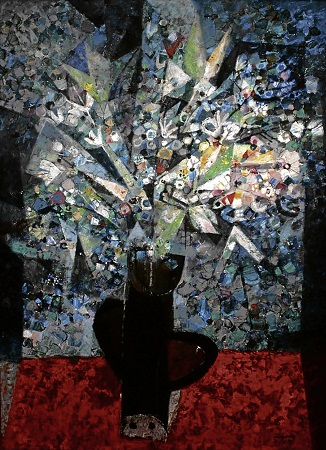
Mauro Malang Santos’ oil on canvas, “Still Life with Vase and Flowers” (1980), was sold for P934,400.


The value of the artwork of contemporary artists, he says, is mainly created by four art advocates. These are the institutions that give out awards or museums that mount exhibits; the commercial art market, or the galleries and auction houses that sell the pieces; reputable private collectors and finally the art critics.

The value, however, is ultimately decided by the buyer.

“You cannot really put a peso sign on the beauty. Ang Kiukok’s work used to shock people because of the angst and the subject matter. But now his art is called beautiful. There is a consensus among these advocates that his art is good,” says Ramon.

Ramon stresses, however, that the prices of contemporary art are also being driven by the global appetite for contemporary art that people want to keep in their homes, and not just sell to the highest bidder.

“Conversations” (2005) by Jose John Santos III was sold for P3,036,800.


“Globally, the appetite for contemporary art started growing in 2005. With the Internet and globalization, and with more people traveling, collectors now want to buy works from overseas and not just collect work done in their own countries,” says Karen.

Veteran and neophyte Filipino collectors are not far behind in the art collection scene, and they see their purchases of local art pieces by both the young and established artists as a vote of confidence in their own country.

“These young artists represent dynamism and confidence in this emerging economy. And how better to represent that emergence in the global scene than an artist selling well?” says Ramon.

There is also equally strong demand for works by established artists from Filipino buyers because they see these pieces as representations of Philippine heritage and culture. By buying a piece of art, they also get a piece of Philippine history.

“Many Filipinos see the purchases as a vote of confidence in the country, and the interest reflects the bullish sentiment prevailing in the country today,” he adds.

“For Philippine artists, this is a great time,” Ramon says.

...the AsPac filmfest nominees

A first for Filipino films: 3 nods in Asia-Pacific awards


Nominees are ‘happy, proud’ for country

By Bayani San Diego Jr.
Philippine Daily Inquirer


NORA Aunor and Brillante Mendoza on the set of “Thy Womb” in Tawi-Tawi.


The three nominations the Philippines received in this year’s Asia-Pacific Screen Awards (APSA) signify that the country remains a strong contender in the international scene, said Filipino filmmaker Brillante Ma. Mendoza.

Brillante was nominated for best director for his Venice entry “Thy Womb,” whose lead star Nora Aunor is in the running for best actress. Scriptwriter Chris Martinez, meanwhile, is vying for best screenplay for “Ang Babae sa Septic Tank.”

Mendoza, who was in Ghent, Belgium, for a screening of “Captive” at the time of the announcement of nominations last Friday, told the Inquirer via SMS: “After having at least nine diverse films at the Busan fest (in South Korea), we got three nods in the region’s top awards. This clearly proves that the country will continue to have a strong presence in world cinema. I’m proud and happy to be the first Filipino director to be recognized by the APSA in that category.”

According to its website, the APSA, which was founded in 2007, seeks to “recognize and promote cinematic excellence and cultural diversity (in) the vast Asia-Pacific region … and is considered as the region’s highest accolade in film.”

This year’s APSA awards ceremony will be held in Brisbane, Australia, on November 23.

Among the best

In 2008, Ishmael Bernal’s “Himala,” which starred Aunor, won the CNN APSA Viewers’ Choice award for Best Asia-Pacific Film of All Time.

“These nominations are a source of pride for our country and countrymen,” Aunor said in Filipino.

 “All these recognitions of the work and art of Filipinos are important. My nomination comes four years after ‘Himala’ won and it inspires me to work even harder. It warms my heart, especially since the honor comes from our fellow Asians.”

“I feel more than validated,” said screenwriter Martinez, who was earlier nominated for the same script at the Asian Film Awards in Hong Kong. “These nominations prove that our films and artists are among the best in the region.”

Martinez hopes the citation will highlight the contributions of writers in local cinema. “Every great movie starts with great writing. It’s my wish that the industry would give more importance to the written word. It’s time screenwriters stop being invisible.”

Martinez said that the entire “Septic” team—including actress Eugene Domingo and director Marlon Rivera—are “praying hard that we win.”

Not just poverty

Joji Alonso, “Septic” producer, said that the nods “call attention to the country … that there is so much talent here, just waiting to be tapped. It also shows that there are other stories, apart from poverty, that we can share with the world.”

The APSA citations prove “that there is still hope for the local film industry. That, if only we could all go out of the box, we would reach our prime much faster,” said Alonso.

Alonso noted that when she first read the “Septic” script, she instantly knew that it would go places.

“It’s both real and surreal.”

Martinez said that “Septic” has been making the rounds of international film fests “for over a year now. It will also be released theatrically in German- and French-speaking countries soon.”

After its Venice, Toronto and Busan screenings, “Thy Womb” will compete in Goa, India, in November and in Dubai in December, Mendoza said. It will have its Austrian premiere at the Vienna fest on October 25 and will be shown in local theaters on November 28.