Saturday, March 16, 2019

...the Filipina Marvel superhero

Here comes Wave, A Filipina superhero from Marvel


Philippine Daily Inquirer
16 March 2019


LOS ANGELES — A Filipina superhero will be gracing the pages of the Marvel Comics soon.

After the release of “Captain Marvel,” the first woman superhero to have its own major film, comic book writer and filmmaker Greg Pak on March 9 unveiled “Wave” on Twitter, designed and co-created by Filipino comic book artist Leinil Francis Yu.

Greg Pak/TWITTER

Wave has been described by Marvel as “a mysterious new Filipino heroine.” She has identifiable Filipino “morena” skin, a green and gold costume, weapons, and she will be teaming up with heroes from China named Aero and Sword Master.


Wave will debut in “War of the Realms: New Agents of Atlas #1,” the first of four “War of the Realms” issues to be released in May. The story will be set in Asia and will center on the New Agents of Atlas led by Korean-American superhero Amadeus Cho (aka Brawn, previously the Hulk).


Joining his team (aside from Wave) are Chinese Kung-Fu master Shang-Chi, Korean-American heroine Silk and SHIELD agent Jimmy Woo.


“Thank you so much for the huge response to Wave, Marvel’s new Filipina superhero, who’ll debut in War of the Realms: New Agents of Atlas #1! Huge thanks to [Leinil Yu], who co-created and designed her,” Pak posted on Twitter.


Marvel’s website, editor Will Moss said that “War of the Realms” will involve all the heroes from the “Avengers,” “Fantastic Four,” “Wolverine” — pretty much the whole line.


All these superheroes are out to fight Malekith, the king of the dark elves, who is conquering all realms including Midgard or Earth.

...the Filipino amulets in Paris

The Philippine flag is raised in this famed Paris museum—all because of our anting-antings


The playwright and curator Floy Quintos has exposed part of our secret soul in the City of Light. At the Musée du Quai Branly along the banks of the Seine, the exposition he put together explores the story of our amulets and the complex, hybrid nature of the Filipino faith .

Renee Ultado | Mar 16 2019 
ABS-CBN News


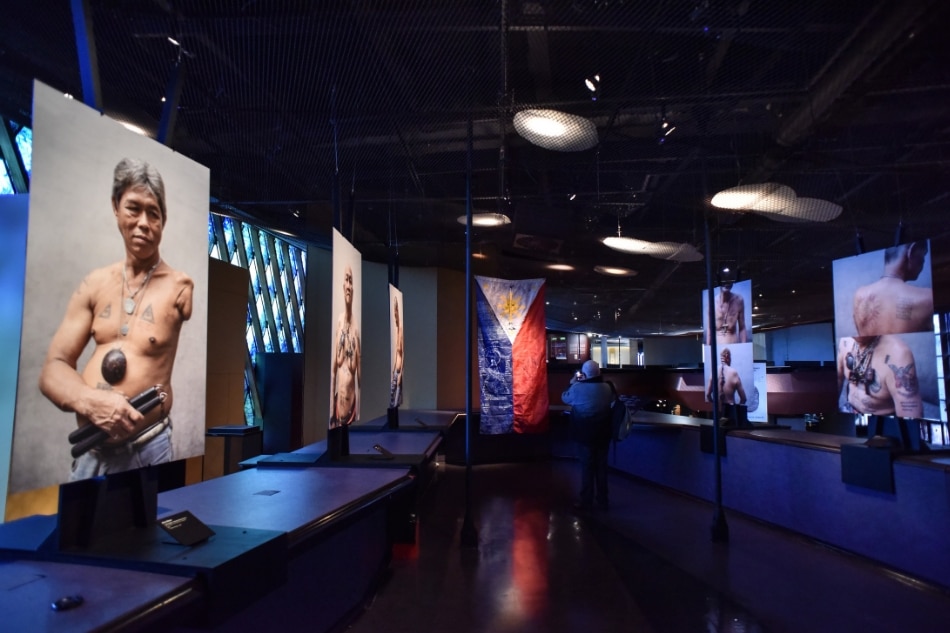
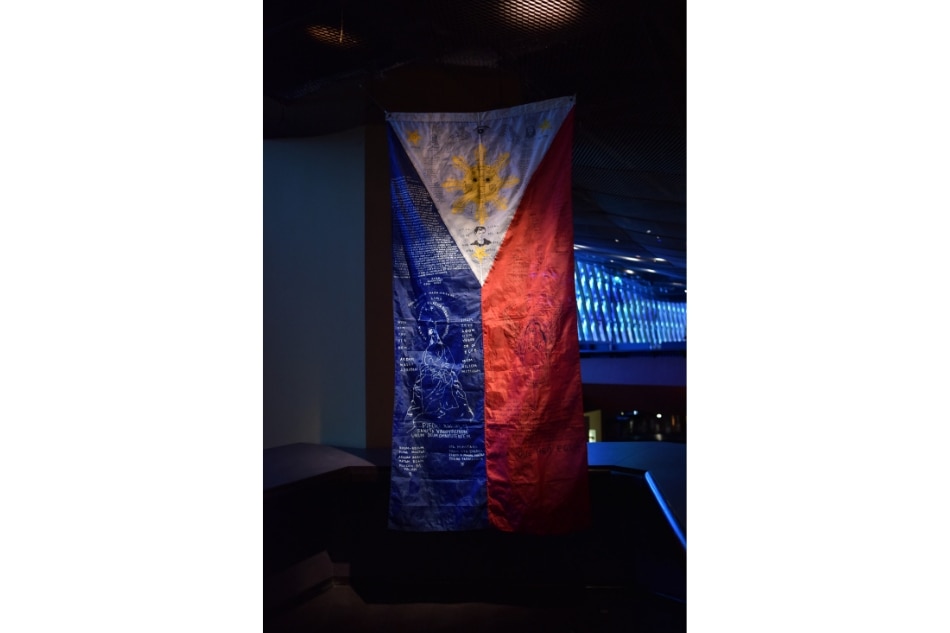
The Philippine Flag stenciled with sacred symbols and incantations, flanked by Dino Dimar photographs of current cult members wearing their anting-antings.

It was a windy Monday morning when the Musee du Quai Branly opened its doors to the press, collaborators, friends, and select patrons for the opening of two exhibitions for Spring. The buzzy Oceania assembles almost 200 archaeological objects and art pieces representative of the Pacific island cultures, while Anting-Anting—to which I was invited—is a more intimate installation telling the story of the historical and contemporary use of protective amulets, talismans, and charms in the Philippines. 


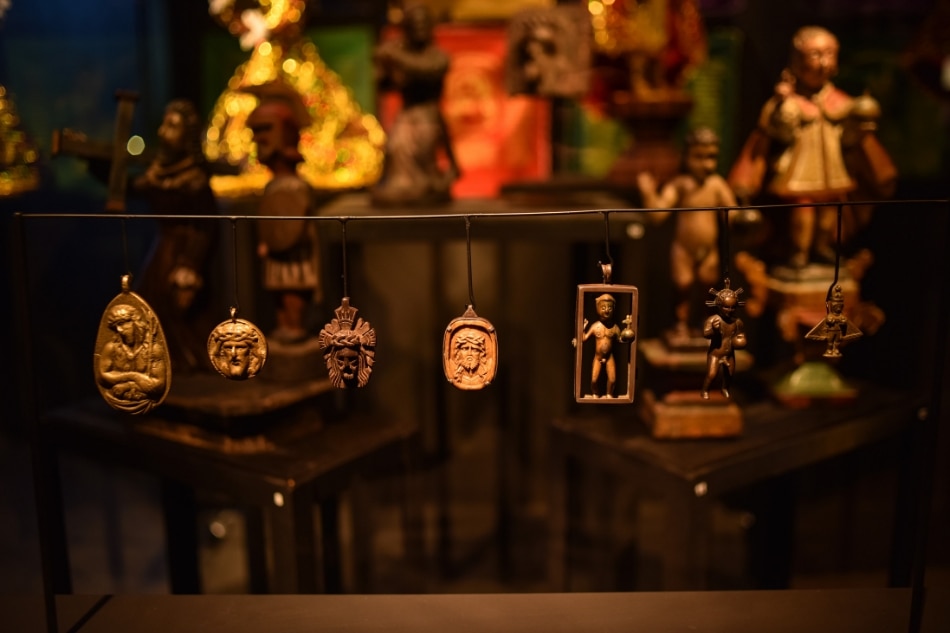
This feels like coming home,  " I said, soliciting a genuine noddy smile from a docent as she ushered me into the exhibit space, an obscure area floating above the museum's permanent collection. It was a half-lie. Whie Santo Niño, the Nazareno handkerchiefs and the odd bits of brass jewelry looked familiar, the whole ensemble felt very foreign to me. Eerie and ominous. A physical manifestation of things I have only heard before.


The exposition entitled Anting-Anting: The Secret Soul of Filipinos explores and demystifies these “charged objects” utilized by a myriad of Filipinos to this very day, from policemen to cult members. An offshoot from a previous exhibit at the Yuchengco Museum in Manila, the collection was built and curated by playwright, director, and antique dealer Floy Quintos.

Images of Jesus Christ and the Santo Niño figure into these ancient amulets in brass and ivory, highlighting the Catholic influence on the animist nature of the anting-anting.

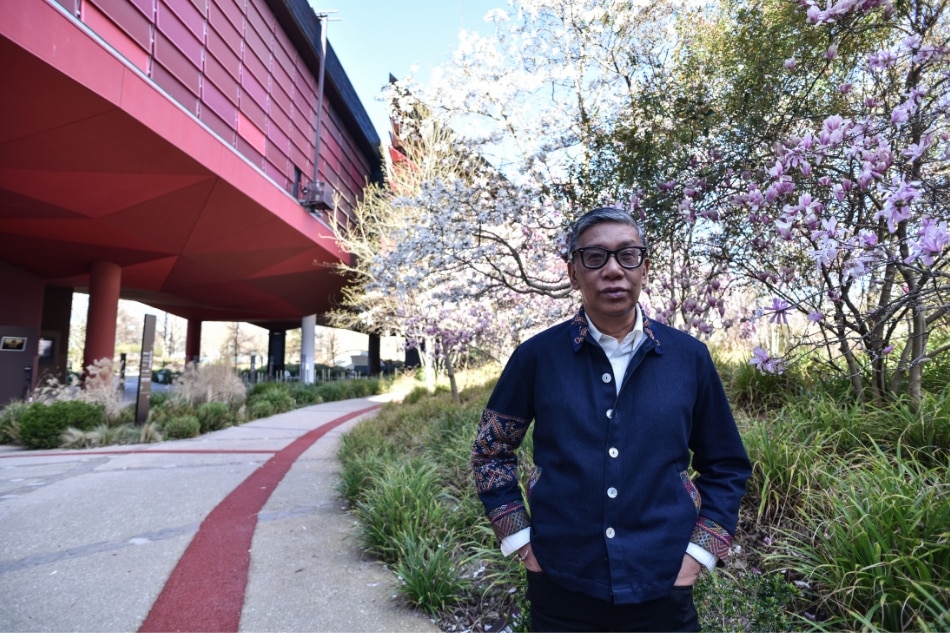
The invitation to show here in Paris came with challenges, mostly reworking the storytelling for a predominantly European audience. “My French colleagues would ask me, okay, how do the objects talk to me? How do we make them engage?” Quintos shares. He had to make the exhibit relatable and transportative even to people who have never been to our islands.

And transportative it was. Utilizing the Atelier Martine Aublet, a space designed to be a “contemporary cabinet of curiosities,” Quintos repackaged the exhibit into smaller pockets of stories. One corner shows Rizalista cult paraphernalia, another reveals blood-stained linen vests with pearl buttons believed to bestow protection against bullets.
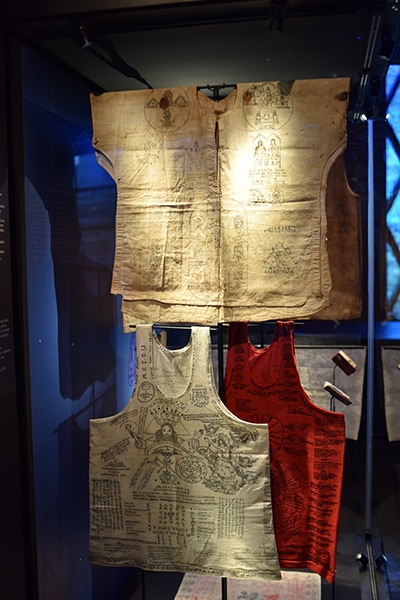

In 1967, socio-political cult Lapiang Malaya marched into Malacañang, equipped only with bolos, anting-anting, and these stenciled shirts believed to make the wearer invincible against bullets.

On the other side, a wall glows with images from a Dino Dimar documentary following the journey of pilgrims to Mount Banahaw. The space is then infused with noises both familiar (the hypnotizing sound of a waterfall hitting the plunge, a solemn rendition of Ama Namin) and unfamiliar (orations in Pig Latin murmured from sacred booklets). One is given the impression of being in the caverns with the faithful as they pray, light candles, slither into crevices, and collect blessed water.

Quintos photographed outside the Musée du Quai Branly in Paris. “My French colleagues would ask me, Okay, how do the objects talk to me? How do we make them engage?” Photographs by Claudio Fleitas.
Some bearing iconographies from the Catholic religion, the anting-anting is one of the many portraits of Hispano-Filipino postcolonial hybridity. Did the Spanish try to make their Gospel more relatable, and the process of evangelization smoother, by incorporating bits and pieces from the native religion? Or did the Filipinos feign allegiance to the Catholic faith while discreetly continuing their animistic ritual under the nose of the colonizer? “That’s the question. It was the kind of dialogue we wanted to highlight,” says Quintos.

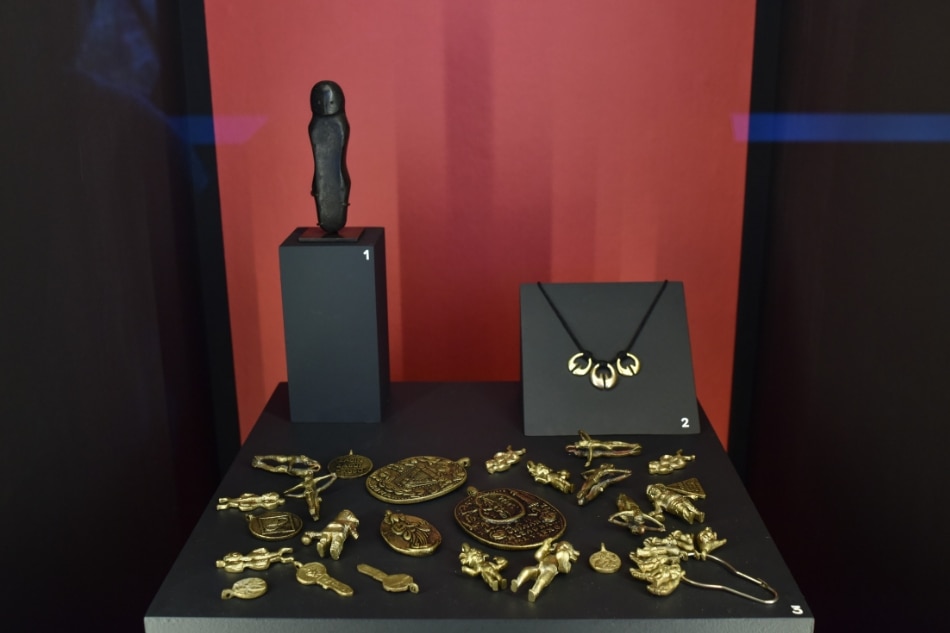
The hi'wong is an Ifugao shaman's amulet functioning as a portable idol (1) while the Lingolingo, also from the Ifugao, is a golden pendant worn to ensure good health, fertility, safety, and bounty. Towering over a collection of commercially-produced amulets (3), it shows the potent pre-colonial origins of the anting-anting and its still-widespread use in contemporary society.
A special nook stripped of protective glass is transformed into a tienda of modern anting-anting, open for people to look closely and even touch. Here, they are less spiritual and somehow devoid of a deeper meaning. Quintos wanted to show how they are today more recognized as popular charms, tailored to augment the spirit or help fix daily woes. It is truly revelatory of the multiple ways we practice our faith in the present. I think of my mother, probably the most Catholic person I know, who keeps her Vatican rosaries next to a Buddha sculpture, or my peers who hear mass on Sundays but wander around with a rose quartz crystal in their coat pocket the rest of the week.
The Philippine flag stenciled with sacred symbols and incantation

The show ends in a juxtaposition of cheap, commercially-made trinkets stacked in a pile under an ancient portable idol carved from stone by the Ifugaos. It shows that the need to always carry a tangible piece of the divine, be it for protection or for luck, is universal and distinctly Filipino. It transcends class, languages, and cultures, and reminds us that everyone, from lovestruck tweens to jittery dispatched soldiers, could use a little help from beyond.

Photographs by Claudio Fleitas
The exhibit Anting-Anting : L'Âme secrète des Philippins runs from March 12 to May 26, 2019 at the Musée du Quai Branly - Jacques Chirac 37 Quai Branly, 75007 Paris, France

Sunday, March 10, 2019

...the world's fastest growing luxury market

The world’s fastest growing luxury market is in the Philippines

Luxury prices in Manila shot up by 11.1 percent year-over-year


The Real Deal
10 March 2019

Welcome to Manila, capital of the Philippines and the fastest growing luxury market in the world.

Manila (Credit: Getty, Pixabay)

The city’s luxury sector saw an 11.1 percent price increase year over year, making it the fastest growing city among 100 global prime markets that Knight Frank tracks, according to Mansion Global. This increase is due to the country’s strong economy and low supply of luxury housing.

But Manila’s growth is much lower compared to top cities in prior years, Knight Frank’s head of international residential research Kate Everett-Allen told Mansion Global.
“In the past 12 years that we have been compiling the index, the top-performing market has yet to record annual growth below 21 percent,” she said. “This is a breakaway from the norm.”
The only other cities this year to show double-digit growth were Edinburgh, Berlin, Munich and Buenos Aires. Knight Frank’s overall prime international residential index rose by 1.3 percent in 2018, the lowest annual growth rate since 2012.
New York’s luxury market declined by 2.5 percent thanks to a strong U.S. dollar, a volatile stock market and an over-saturated luxury market. It was still the third most expensive city to buy a prime property, with $1 million getting buyers about 330 square feet.
Monaco was the most expensive city by this metric, with $1 million buying just 172 square feet of space. [Mansion Global] – Eddie Small

Sunday, March 3, 2019

...the Asia's best currency in February 2019

Philippine Peso Surprises to become Asia's Best Currency 


David Finnerty
Bloomberg| 03March 2019


The Philippine peso has defied a yawning current-account deficit to emerge as Asia’s best-performing currency in February. And it may continue to surpass its peers.


Peso bulls say record remittances, rising investment and a buoyant domestic economy will propel further gains in the currency. Easing inflation could also lend a hand, as higher real yields burnish the appeal of Philippine bonds.
The peso is among Asia’s biggest turnaround stories, as the currency bounced back from a 13-year low after a slew of economic reforms and a $170 billion infrastructure spending plan revived sentiment. Proactive central bank policy has also helped win over skeptics.
“The peso has been stronger recently and could continue to outperform in the region, amid sustained net foreign portfolio investments on a widely expected further declining trend of local inflation," said Mike Ricafort, economist at Rizal Commercial Banking Corp. in Manila.
The Philippine currency strengthened 0.8 percent in February to 51.70 per dollar, the best performance among Asian currencies. It has climbed since the start of the year, as a pause in Federal Reserve tightening and easing global trade tensions fueled demand for developing-nation assets.
The peso was among the hardest hit in the emerging-market sell-off last year, tumbling to a 13-year low of 54.41 in October as investors punished economies running current-account deficits.
Technicals back the case for further peso gains. The dollar-peso currency pair remains in a bear trend, hovering above initial support at 51.90, its Feb. 13 low. The pair’s slow stochastics, a momentum indicator, signals it may drop further in the near term, with the %D line reading 43 and falling.
Sentiment toward the peso has recovered even after the central bank forecast the nation’s current-account deficit will widen to 2.3 percent of gross domestic product in 2019, the biggest shortfall since 2001. The recent rebound in crude prices threatens to worsen the gap, as the Philippines imports almost all its oil requirements.
Investors are betting on the peso after foreign investment into Philippine stocks and bonds recorded a net inflow of $763 million in January, more than four times the level a year ago. Remittances from Filipinos working abroad climbed to an all-time high of $2.85 billion in December.
Inflation data due March 5 could provide more fodder for peso bulls. Consumer-price gains may have eased to a one-year low of 4.0 percent in February, according to a Bloomberg survey of economists on Friday afternoon, and within the central bank’s target band of 2 to 4 percent. Price pressures have waned since touching a nine-year high in September, thanks to government measures to boost food supplies.
This augurs well for peso government bonds, which gained 0.4 percent in February, the seventh-best performer among 34 sovereign markets tracked by Bloomberg. Waning price pressures will boost real yields on Philippine debt, particularly as the central bank remains in hawkish mode for now.
Ten-year peso bonds offer a real yield of 2 percent, compared with about 5 percent for Indonesian securities and Indian debt.
But for peso bears, the outlook is less certain.
— With assistance by Ditas B Lopez, and Masaki Kondo