Filipino Food Has a Lot to Gain As It Builds Traction in the United States
The young chefs behind the evolving new wave of Filipino food are more than ready to share their beloved cuisine with a bigger audience.
Morena Duwe
vice.com
04 September 2019
Lumpia are the glimmering golden pillars of Filipino cuisine.
Usually containing minced meat and vegetables, these deep-fried rolls may also contain raisins, jackfruit, or bananas. As crisp as autumn leaves, lumpia are famously made in large quantities and best enjoyed with loved ones. Like their delicious cousin, the egg roll, they originated in China, and were wholeheartedly adopted and then reinvented in the Philippines along with other neighboring island nations. They are a gateway into an underrepresented cuisine—a gustatory delight for palates of all ethnicities. But finally, after decades of being unacknowledged by America’s foodie culture, non-Filipinos are beginning to explore what lies beyond the lumpia when it comes to Filipino cuisine.
According to Diana Ting Liu Wu’s Asian Pacific Americans in the Workplace, a collection of case studies that examines the position of Asian Pacific Americans in the U.S. workforce, there are more ethnic Filipinos in Los Angeles "than in any other city except Manila.” Since the book’s publication in 1997, LA’s Filipinx diaspora has significantly increased, so it’s strange that in a county with the largest population of Filipino-Americans, their food is not fully ingrained into the city’s culinary culture. As the late Filipino writer, teacher, cultural historian, and food critic Doreen Fernandez was quoted as saying in a recent New York Times profile, “One did not take bosses, foreigners, dates or VIPs to have Filipino food at a restaurant; it wasn’t considered ‘dignified enough.”’
However, that perception has finally changed.
On the corner of a Hollywood strip mall on Vine Street, adjacent to a Cuban supper club that bumps salsa music at 120 decibels, sits Barkada—a hip, nascent Filipino tapas restaurant and lounge that offers live music, moody lighting, and community fundraisers. Run by longtime friends Paul Montoya, Jay Baluyot, and French-trained chef Josh Robles, Barkada was opened in 2017. Their friendship yielded the restaurant’s name, which is Tagalog for your clique, crew, gang, tribe, or whatever you call your chosen family, and the food is an amalgamation of traditional family recipes and chef Robles’ innovative Asian-inspired creations. When asked who owns the joint, they simply reply: “It’s a family business.”
“It all started because we wanted to represent Filipino food in a different way,” says Montoya, over a plate of his Lola’s (Tagalog for grandmother) famed calamansi chicken wings. “Growing up in LA, people used to joke around with us, saying we eat dogs and cats. That was a common thing I’d hear back in the day—that’s what people thought about Filipino food.”
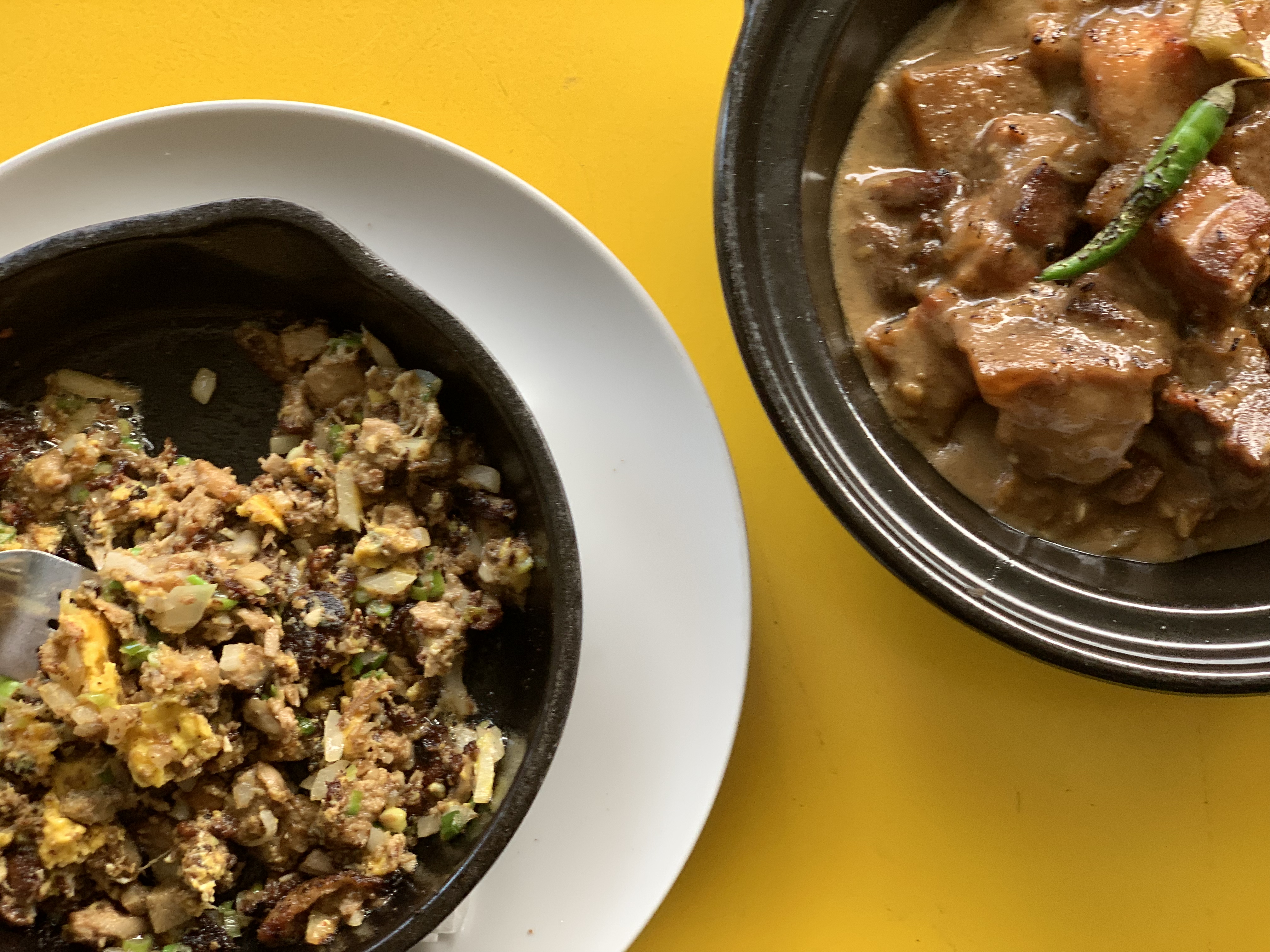
Charles Olalia’s popular Ma’am Sir in Silver Lake—who Montoya and Baluyot fondly consider to be part of their ‘barkada’—is among the new wave of restaurants to spark this gustatory renaissance. After attending culinary school in Manila, Olalia moved stateside, ultimately landing in Los Angeles. He first opened Rice Bar, a successful counter restaurant in DTLA that served Filipino-inspired grain bowls, which built the foundation for him to expand with Ma’am Sir. Serving reimagined classics like sizzling pork sisig and banana bibingka—typically a baked rice cake that is sometimes topped with salted duck egg and especially popular during Christmas—Ma’am Sir has been lauded by the media, including a glittering write-up in the Los Angeles Times earlier this year.
Tucked away in strip malls and Filipino neighborhoods across the city, Filipino restaurants in LA have often been overlooked by non-Filipinos, and usually contain mostly, if not all, Filipinx patrons. Almost anyone who passes a sushi or pho restaurant knows exactly what is served. However, the Filipino food vernacular is commonly relegated to those who grew up eating it (and those with Filipinx relatives or close friends). Turo turo joints—Tagalog for “point point,” referring to the way in which the food is ordered—are popular among the diaspora, but unbeknownst to most non-Filipinx Angelenos. In group dining scenarios when restaurant suggestions are made, you will likely hear mentions of Thai, ramen, Korean barbecue, pho, sushi, and Indian joints—Asian cuisines recognized the world over. Rarely will Filipino food be included in the conversation.
Food has long been a gateway to cultural understanding. Anthony Bourdain brought the people and cuisines of tension-filled regions like Israel and Congo directly into our living rooms, examining conflict through the lens of food. Conflict Kitchen in Pittsburgh, Pennsylvania rotates its menu depending on the people or country with which the United States is in conflict, encouraging patrons to reshape their understanding of the culture, politics, and issues of the focus region. Based on the impact that Bourdain and establishments like Conflict Kitchen have made, using food to incite dialogue and connection works, and now more than ever, people of all ethnic backgrounds are open-minded to trying foreign foods like the Filipino delicacy balut (fetal duck egg—which Bourdain has eaten, and enjoyed, on-camera multiple times).
But while most signs point to positive in regards to the popularization of Filipino food, is there a risk of losing its authenticity?
The ubiquity of Japanese and Chinese foods are good representations of the proliferation of Asian cuisine in the U.S. While sushi and potstickers have become household names, these food traditions have been diluted and modified to better suit Western palates and aesthetics. The ever-popular inside-out California roll, for example—placing the nori seaweed on the inside and the rice on the outside to make the roll appear more appetizing—was created in North America. And as many might already know, the fortune cookie is not a tradition in China.
At Barkada, as well as several other modern Filipino restaurants like Ma’am Sir, the goal is to represent Filipino food in a new and playful way. By taking traditional dishes like chicken adobo and elevating the ingredients—Barkada subs chicken for beef short ribs—the traditional flavors are still the foundation, just reinvented (much like pancit, which was created after China introduced noodles to the Philippines). Instead of offering large portions of these dishes, typical of most Filipino restaurants, non-Filipinos who are new to the flavors and words of Filipino food are able to try small portions without committing to one large dish, creating a perfect entry point for those unfamiliar with the cuisine. But, like Japanese and Chinese food, a bit of the tradition gets lost in the innovation.
“A lot of Filipinos love seeing these elevated versions of classic recipes but some of the purists don't get it,” Baluyot explains while pointing to a dish of short rib kare-kare, a savory peanut-based stew traditionally cooked with oxtail. “That's what always happens with generation gaps, though, no matter the culture. Whenever a new generation changes something that hasn’t changed for a long time, the older generation doesn’t like it.”
Because Filipino food is still in its nascency in America, most Filipinx restaurateurs including, Montoya and Baluyot, believe the popularization of their beloved cuisine doesn’t risk losing anything. In fact, they believe it has more to gain than to lose. Nicole Ponseca, author of I Am a Filipino: And This Is How We Cook and the founder of Maharlika and Jeepney restaurants in New York City echoes their sentiment about this proliferation. Though her career began in advertising, she discovered her true calling after noticing New York City’s lack of authentic Filipino food and dedicated her life to changing that.
“From my days of advertising, I knew that Filipinos had no representation in media,” Ponseca shares. “I had no intention of being a restaurant person, I was just trying to find the easiest way to make an impact. Restaurants are by no means easy, but food was the easiest way I could translate culture and dimensionalize people. I've been at this for 20 years and when I started there was very little representation for Filipinos—not that I'm the first Filipino restaurant—but I think that we were the first to do it in a way that was political and offered a social commentary on representation. We knew that if we did it well, it would keep the door open for other Filipino restaurants, chefs, and entrepreneurs.”
Where Barkada seeks to introduce Filipino cuisine through the modernization of old family recipes, Ponseca’s goal is to serve purely traditional dishes, such as the aforementioned balut, and dinuguan, a rich, pork stew simmered in pig’s blood, garlic, chili, and vinegar. While offering a contemporary setting—most cafeteria-style Filipino restaurants are devoid of trendy ambiance—Ponseca aids in the purging of shame and exoticism around foreign foods.
“When you stop talking about exoticism, that's when we become part of the lexicon,” she explains. “This is what we eat and we’re not ashamed or on display. It's not a raised eyebrow. It’s not being embarrassed when you open your Tupperware of food at school. When our story becomes normalized, we gain interest and respect and appreciation.”
Many modern Filipino restaurants, including Barkada, Jeepney, and Maharlika, have introduced their diverse crowds of diners to kamayan (Tagalog for “by hand”) feasts, a style of Filipino cuisine where banana leaves are splayed on a table and piled with seafood, meat, rice and vegetables, eaten sans silverware. This was a standard way of eating in the Philippines before Spanish conquistadors colonized the archipelago in 1565 and introduced cutlery.
“I did a lot of fucking research here; it wasn’t just me opening up a restaurant,” Ponseca declares. “I knew that going into it I would be deconstructing colonialism. It’s not just a restaurant, it’s about how I can push Filipino food forward so there’s no sense of euphemisms, there's no dumbing things down.”
Now, Filipino food is having its long-awaited moment. In an era where adventurous eating is cool, helped in part by Anthony Bourdain, the door for other underrepresented cuisines to find their limelight in American food culture is wide open. Whether it be through innovation, fusion, or standing by tradition, Filipino food has earned a seat at the table.
“Filipino food is finally getting acknowledged,” Montoya shares. “It has a few more years to becoming a household name, like other Asian cuisines, but I’m excited to see where it goes next. Even if it’s the fusion places that are putting it on the map right now, it’s a gateway to the traditional spots that have always existed. And that's a good thing.”
The young chefs behind the evolving new wave of Filipino food are more than ready to share their beloved cuisine with a bigger audience.
Morena Duwe
vice.com
04 September 2019
Lumpia are the glimmering golden pillars of Filipino cuisine.
Usually containing minced meat and vegetables, these deep-fried rolls may also contain raisins, jackfruit, or bananas. As crisp as autumn leaves, lumpia are famously made in large quantities and best enjoyed with loved ones. Like their delicious cousin, the egg roll, they originated in China, and were wholeheartedly adopted and then reinvented in the Philippines along with other neighboring island nations. They are a gateway into an underrepresented cuisine—a gustatory delight for palates of all ethnicities. But finally, after decades of being unacknowledged by America’s foodie culture, non-Filipinos are beginning to explore what lies beyond the lumpia when it comes to Filipino cuisine.
According to Diana Ting Liu Wu’s Asian Pacific Americans in the Workplace, a collection of case studies that examines the position of Asian Pacific Americans in the U.S. workforce, there are more ethnic Filipinos in Los Angeles "than in any other city except Manila.” Since the book’s publication in 1997, LA’s Filipinx diaspora has significantly increased, so it’s strange that in a county with the largest population of Filipino-Americans, their food is not fully ingrained into the city’s culinary culture. As the late Filipino writer, teacher, cultural historian, and food critic Doreen Fernandez was quoted as saying in a recent New York Times profile, “One did not take bosses, foreigners, dates or VIPs to have Filipino food at a restaurant; it wasn’t considered ‘dignified enough.”’
However, that perception has finally changed.
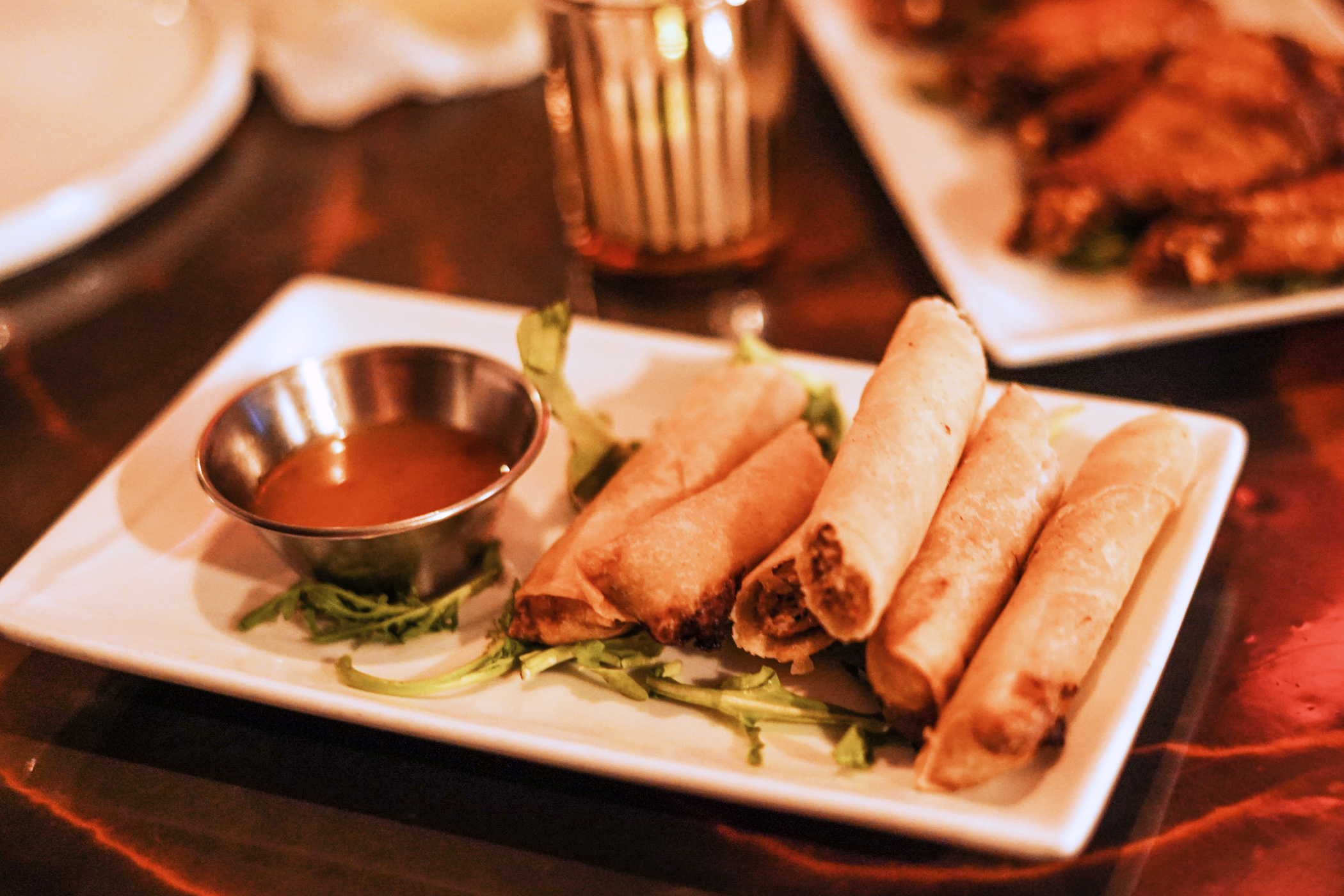 |
| Lumpia at Barkada. Photo by Miles Najera |
“It all started because we wanted to represent Filipino food in a different way,” says Montoya, over a plate of his Lola’s (Tagalog for grandmother) famed calamansi chicken wings. “Growing up in LA, people used to joke around with us, saying we eat dogs and cats. That was a common thing I’d hear back in the day—that’s what people thought about Filipino food.”
Charles Olalia’s popular Ma’am Sir in Silver Lake—who Montoya and Baluyot fondly consider to be part of their ‘barkada’—is among the new wave of restaurants to spark this gustatory renaissance. After attending culinary school in Manila, Olalia moved stateside, ultimately landing in Los Angeles. He first opened Rice Bar, a successful counter restaurant in DTLA that served Filipino-inspired grain bowls, which built the foundation for him to expand with Ma’am Sir. Serving reimagined classics like sizzling pork sisig and banana bibingka—typically a baked rice cake that is sometimes topped with salted duck egg and especially popular during Christmas—Ma’am Sir has been lauded by the media, including a glittering write-up in the Los Angeles Times earlier this year.
Tucked away in strip malls and Filipino neighborhoods across the city, Filipino restaurants in LA have often been overlooked by non-Filipinos, and usually contain mostly, if not all, Filipinx patrons. Almost anyone who passes a sushi or pho restaurant knows exactly what is served. However, the Filipino food vernacular is commonly relegated to those who grew up eating it (and those with Filipinx relatives or close friends). Turo turo joints—Tagalog for “point point,” referring to the way in which the food is ordered—are popular among the diaspora, but unbeknownst to most non-Filipinx Angelenos. In group dining scenarios when restaurant suggestions are made, you will likely hear mentions of Thai, ramen, Korean barbecue, pho, sushi, and Indian joints—Asian cuisines recognized the world over. Rarely will Filipino food be included in the conversation.
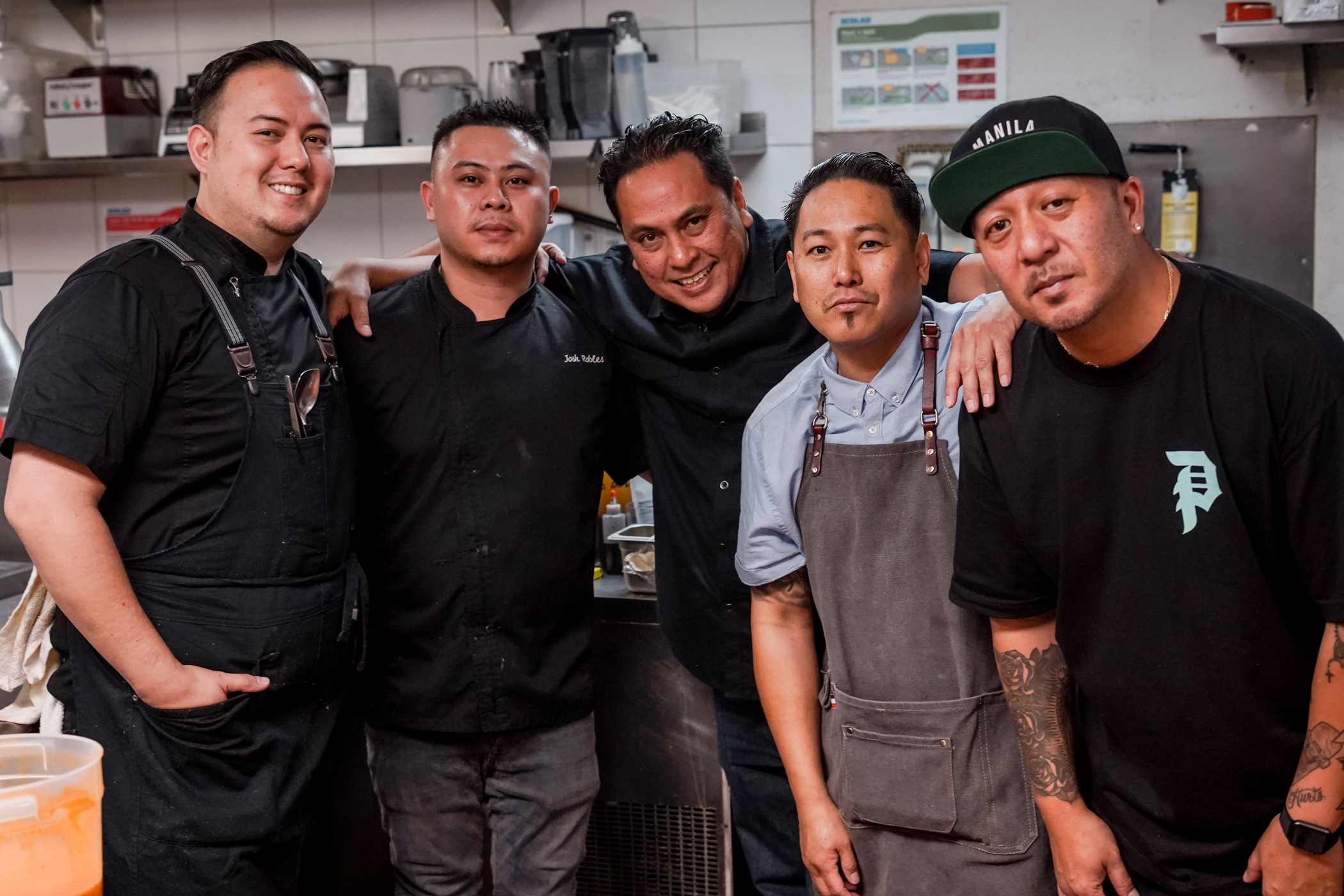 |
| The team at Barkada. Photo by Miles Najera |
But while most signs point to positive in regards to the popularization of Filipino food, is there a risk of losing its authenticity?
The ubiquity of Japanese and Chinese foods are good representations of the proliferation of Asian cuisine in the U.S. While sushi and potstickers have become household names, these food traditions have been diluted and modified to better suit Western palates and aesthetics. The ever-popular inside-out California roll, for example—placing the nori seaweed on the inside and the rice on the outside to make the roll appear more appetizing—was created in North America. And as many might already know, the fortune cookie is not a tradition in China.
At Barkada, as well as several other modern Filipino restaurants like Ma’am Sir, the goal is to represent Filipino food in a new and playful way. By taking traditional dishes like chicken adobo and elevating the ingredients—Barkada subs chicken for beef short ribs—the traditional flavors are still the foundation, just reinvented (much like pancit, which was created after China introduced noodles to the Philippines). Instead of offering large portions of these dishes, typical of most Filipino restaurants, non-Filipinos who are new to the flavors and words of Filipino food are able to try small portions without committing to one large dish, creating a perfect entry point for those unfamiliar with the cuisine. But, like Japanese and Chinese food, a bit of the tradition gets lost in the innovation.
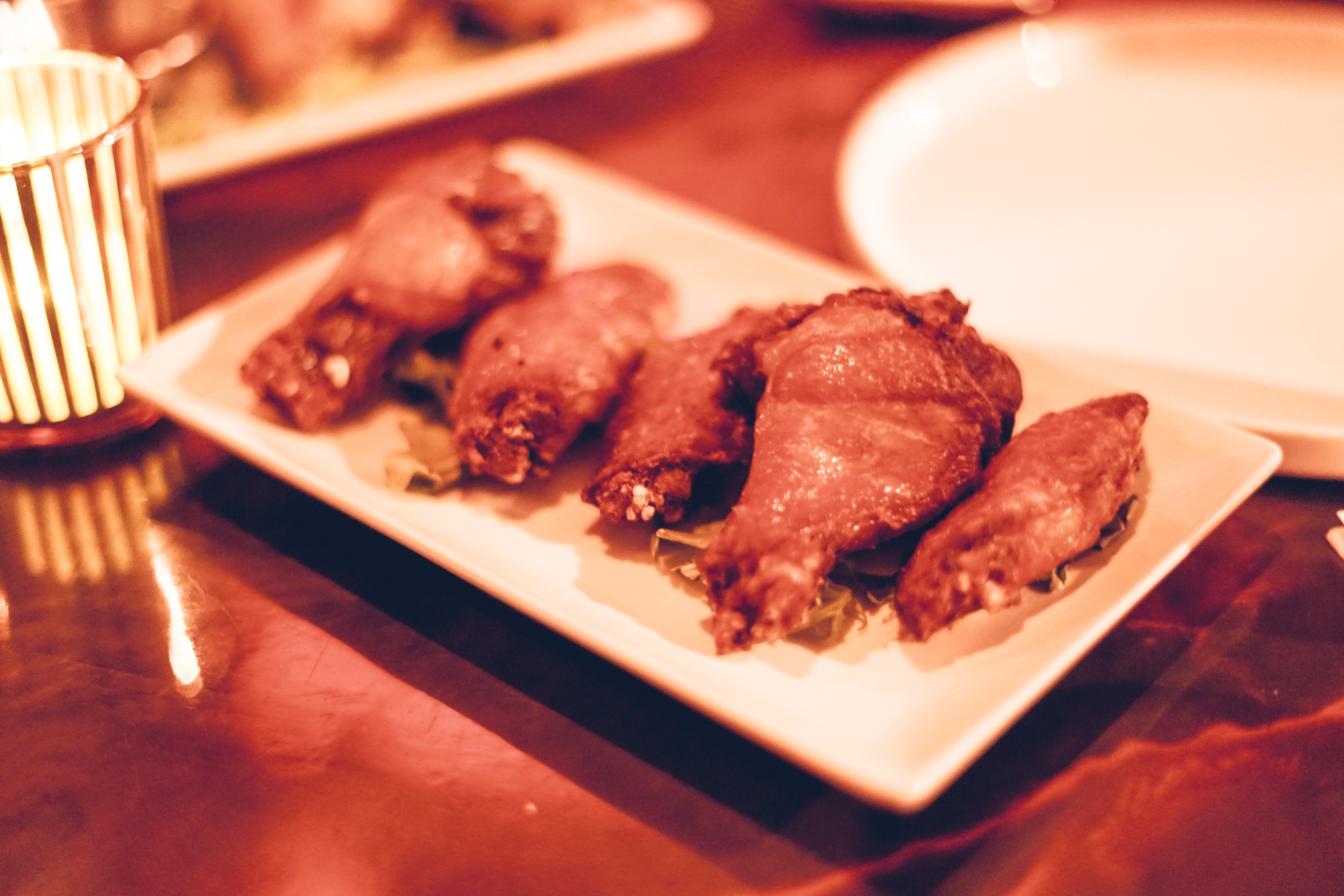 |
| The calamansi chicken wings at Barkada. Photo by Miles Najera |
Because Filipino food is still in its nascency in America, most Filipinx restaurateurs including, Montoya and Baluyot, believe the popularization of their beloved cuisine doesn’t risk losing anything. In fact, they believe it has more to gain than to lose. Nicole Ponseca, author of I Am a Filipino: And This Is How We Cook and the founder of Maharlika and Jeepney restaurants in New York City echoes their sentiment about this proliferation. Though her career began in advertising, she discovered her true calling after noticing New York City’s lack of authentic Filipino food and dedicated her life to changing that.
“From my days of advertising, I knew that Filipinos had no representation in media,” Ponseca shares. “I had no intention of being a restaurant person, I was just trying to find the easiest way to make an impact. Restaurants are by no means easy, but food was the easiest way I could translate culture and dimensionalize people. I've been at this for 20 years and when I started there was very little representation for Filipinos—not that I'm the first Filipino restaurant—but I think that we were the first to do it in a way that was political and offered a social commentary on representation. We knew that if we did it well, it would keep the door open for other Filipino restaurants, chefs, and entrepreneurs.”
Where Barkada seeks to introduce Filipino cuisine through the modernization of old family recipes, Ponseca’s goal is to serve purely traditional dishes, such as the aforementioned balut, and dinuguan, a rich, pork stew simmered in pig’s blood, garlic, chili, and vinegar. While offering a contemporary setting—most cafeteria-style Filipino restaurants are devoid of trendy ambiance—Ponseca aids in the purging of shame and exoticism around foreign foods.
 |
| Photo by Marts Romero |
Many modern Filipino restaurants, including Barkada, Jeepney, and Maharlika, have introduced their diverse crowds of diners to kamayan (Tagalog for “by hand”) feasts, a style of Filipino cuisine where banana leaves are splayed on a table and piled with seafood, meat, rice and vegetables, eaten sans silverware. This was a standard way of eating in the Philippines before Spanish conquistadors colonized the archipelago in 1565 and introduced cutlery.
“I did a lot of fucking research here; it wasn’t just me opening up a restaurant,” Ponseca declares. “I knew that going into it I would be deconstructing colonialism. It’s not just a restaurant, it’s about how I can push Filipino food forward so there’s no sense of euphemisms, there's no dumbing things down.”
Now, Filipino food is having its long-awaited moment. In an era where adventurous eating is cool, helped in part by Anthony Bourdain, the door for other underrepresented cuisines to find their limelight in American food culture is wide open. Whether it be through innovation, fusion, or standing by tradition, Filipino food has earned a seat at the table.
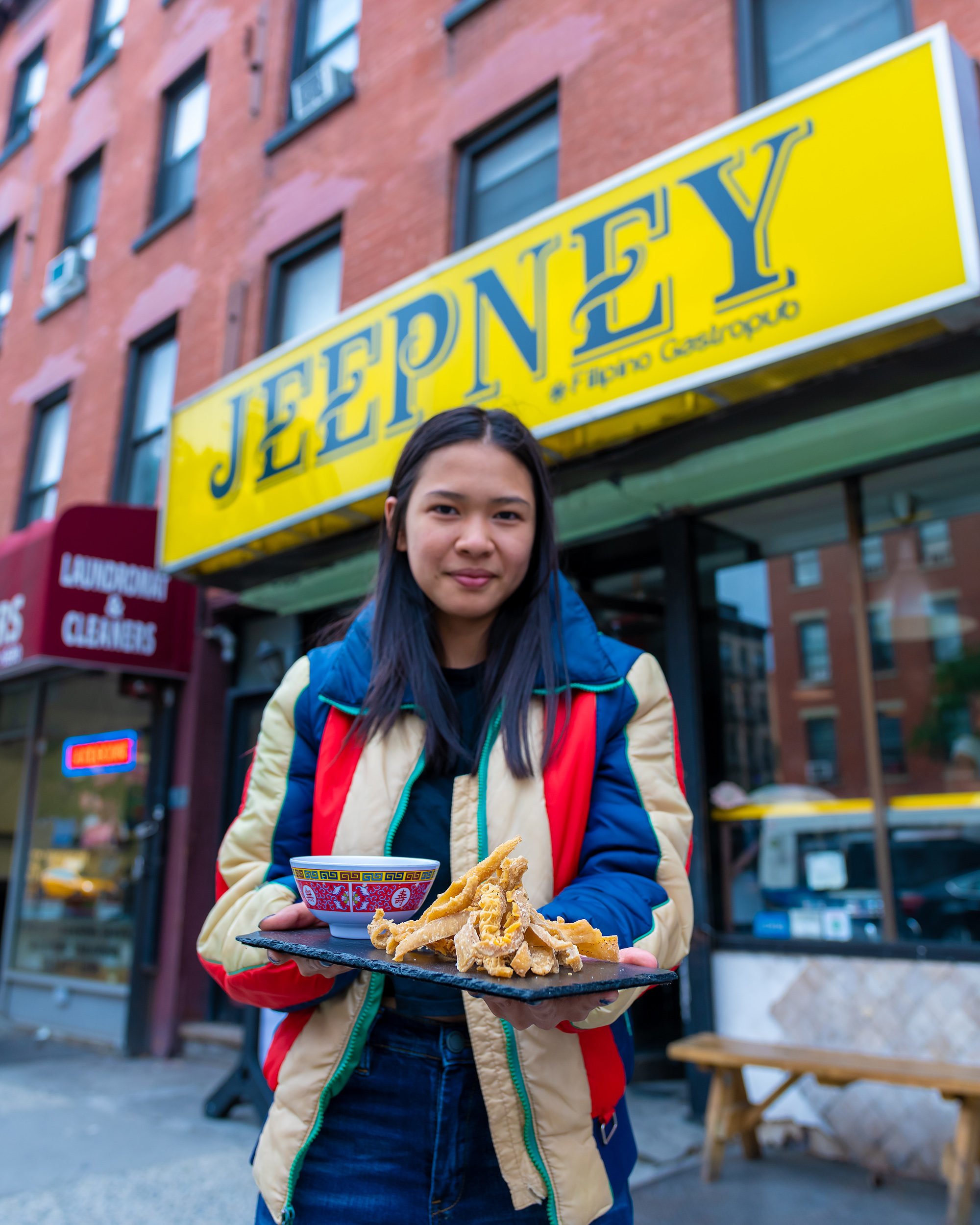 |
| Photo by Marts Romero |
“Filipino food is finally getting acknowledged,” Montoya shares. “It has a few more years to becoming a household name, like other Asian cuisines, but I’m excited to see where it goes next. Even if it’s the fusion places that are putting it on the map right now, it’s a gateway to the traditional spots that have always existed. And that's a good thing.”