Friday, September 19, 2014

...the PH ranking in 2016

PHL seen in world's top 30% in competitiveness by 2016 – DTI's Domingo


September 19, 2013
GMA News
 
The Philippines is on track to being ranked within the top 30 percent economies in various competitiveness surveys by 2016, a Cabinet official said Thursday.

“We will be in the top 30 percent in most if not all competitiveness surveys... by 2016,” Department of Trade and Industry Secretary and National Competitiveness Council (NCC) public sector chair Gregory Domingo told a press briefing.

For example, Domingo said the Philippines competitiveness ranking in the World Bank's Doing Business report is seen increasing to the 62nd spot “or better” in 2016.

Based on the World Bank's Doing Business report, the Philippines ranks 138th out of 185 countrie

The World Economic Forum, on the other hand, recently moved the Philippines six places up to 59th in its Global Competitiveness Report of 148 countries.

Domingo said that government reforms creating a conducive environment “will be in place” by 2015.

“Once we achieve these reforms, doing business in the Philippines will be easier and that should improve our rankings,” he said.

At the same briefing, NCC private sector co-chair Guillermo Luz said the country is likely to improve its ranking by 20 to 25 places in the next Doing Business report next month.

“We have not been doing well in this report so we spent a lot of time reviewing this report,” he said, adding that the NCC's report sent to the World Bank shows improvement in eight out of the ten indicators being tracked.

Reforms cited include cutting down steps and days in starting a business, dealing with construction permits, getting electricity, registering property, getting credit, protecting investors, paying taxes and trading across borders.

Officials maintained that reforms are being undertaken not to improve the country's competitiveness ranking, but to attract more businesses and investments to the country.

“We are putting in reforms for entrepreneurs. If our ranking does not improve but more want to invest here, then we are competitive,” Luz said.

The government wants to seize the Philippines' favorable economic conditions – robust growth as well as healthy payments and fiscal position – by providing a more conducive environment for businesses and investments.

“Our relative competitiveness in Asia and ASEAN [Association of Southeast Asian Nations] is the best it has ever been and will continue to improve,” Domingo said. – SOA/BM, GMA News


Wednesday, September 17, 2014

...the Gilas FIBA rank

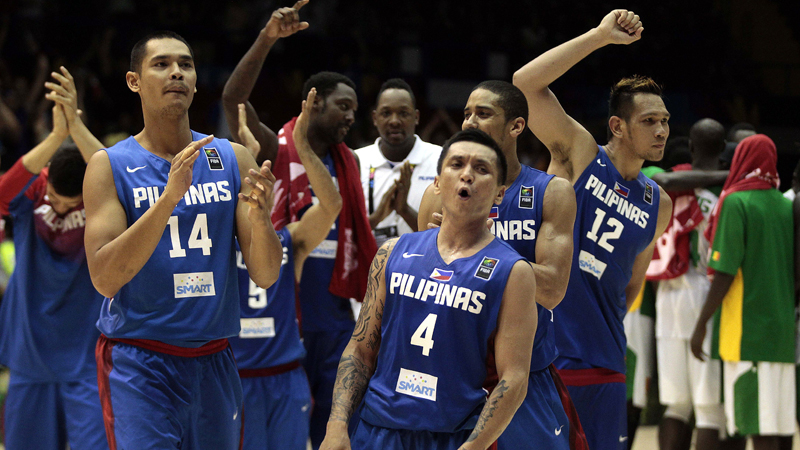
Philippines climbs to world No. 31 in latest Fiba Rankings


By Mark Giongco |INQUIRER.net


Philippines' Japeth Aguilar, left, and teammate Jim Alapag, right, celebrates after winning the match at the end of the match  against Senegal during the Group B Basketball World Cup match between the Philippines and Senegal in Seville, Spain, Thursday, Sept. 4, 2014. The 2014 Basketball World Cup competition will take place in various cities in Spain from Aug. 30 through to Sept. 14. AP
Philippines’ Japeth Aguilar, left, and teammate Jim Alapag, right, celebrates after winning the match at the end of the match against Senegal during the Group B Basketball World Cup match between the Philippines and Senegal in Seville, Spain, Thursday, Sept. 4, 2014. AP FILE PHOTO


MANILA, Philippines — Gilas Pilipinas’ gutsy showing in the 2014 Fiba World Cup had the country climbing three spots to No. 31 in the latest Fiba Rankings.

The Philippines went just 1-4, with its only win coming at the expense of Senegal and, failed to advance into the second round of the tournament but gave its opponents a run for their money.

Playing in its first appearance in the world stage in 36 years, Gilas was deemed as a pushover in Group B with powerhouses Croatia, Greece and Argentina as overwhelming favorites and Puerto Rico and Senegal also favored over the Filipinos.

But the perception quickly changed when Gilas dragged Croatia into overtime in its first game before losing by just three points. The Philippines then gave Greece a hard time too and did so too to world No. 3 Argentina. And if not for JJ Barea’s late-game heroics for Puerto Rico, Gilas could’ve been 4-1 with the 12-point loss at the hands of the Greeks the only convincing defeat.

The early exit though, won’t undermine the Philippines’ steady improvement over the past several years as the country aims to put itself back as one of the teams to reckon with not only in Asia but in the world. And the improvement from 34th to 31st in the world is a testament to it.

Meanwhile, Team USA, bannered by NBA stars, remained at the helm after its gold-medal romp. Spain, despite a disappointing fifth place finish, stayed in second. Argentina (3rd) and Lithuania (4th) also maintained their positions.

France, which knocked off host Spain in the quarterfinals and went on to bag the bronze medal, improved three places to enter the top five.

Greece slipped five spots to No. 10, Croatia upped its ranking to 12th, Puerto Rico also improved to 15th while Senegal, the biggest movers, leaped 11 places to 30th after advancing to the Round of 16.

The Philippines is the fourth highest-ranked squad in Asia, trailing China (14), Iran (17), and Korea (27).
 

Friday, September 12, 2014

...the PH global banks

8 Philippine banks make it to global rankings list


By Doris C. Dumlao
inquirer.net
12 September 2014


The SM group’s banking arm BDO Unibank Inc. has kept its bragging rights as the Philippines’ top bank in the Top 1,000 Global Banks Ranking 2014 report of British publication The Banker.

BDO, which placed 268th in the latest ranking, led the roster of eight Philippine banks that landed on the global list.

The seven other Philippine banks that made it to the list were Metropolitan Bank and Trust Co. (314th), Bank of the Philippine Islands (382nd), Philippine National Bank (506th), Rizal Commercial Banking Corp. (590th), Security Bank Corp. (680th), China Banking Corp. (681st) and Union Bank of the Philippines (751st).

The banks were ranked by The Banker on the basis of strength of their tier1 or core capital, assets, performance and earnings.

Globally, most of the banks in the top 10 were either from China or the United States, with the exception of one British (HSBC) and one Japanese bank (Mitsubishi UFJ). The top five banks globally were ICBC (1st), China Construction Bank (2nd), JP Morgan Chase (3rd), Bank of America (4th), HSBC (5th), Citigroup (6th), Bank of China (7th), Wells Fargo & Co. (8th), Agricultural Bank of China (9th) and Mitsubishi UFJ Financial Group. (10th).

The Banker’s Top 1000 World Banks ranking has been setting the industry benchmark since 1970, providing comprehensive intelligence about the health and wealth of the banking sector. The report enables investors and clients worldwide to assess the strength and weakness of the banks, identify banking partners for the future and track the big movers and new arrivals in the sector.


...the Philippines in the eye of a German

Discover PH now, German tells Pinoys


There’s nothing wrong about wanting to see all of the world, but a foreigner has this advice for Filipinos setting their eyes abroad: Discover the Philippines first.

“The foreign always appears more exotic and intriguing than your own home country,” said Philipp Dukatz, a German who spent three months going around the Philippines.

“But the Philippines has so much to offer that it would be a shame to not explore it before venturing out into the world,” he told Yahoo Philippines through email.

In June, Dukatz made waves in the online Filipino community after he shared his adventures in a blog post titled, “Roundup Philippines: A country that has it all.”

The blog offered Filipinos a fresh look into local destinations that may have grown too familiar to them, this time through the eyes of an outsider.

From his account, it could be said that Dukatz has seen—and loved—it all: the white sand beaches of Boracay, the clear waters of Palawan, and the steep slopes of Sagada.


No need to look too far

“It is all there, all there for the taking and for you it is not even far away,” Dukatz told Filipinos, adding that “now is the best time to discover the Philippines.”

“Imagine that foreign tourists like myself pay a lot of money for an overseas flight to come and see the beauty of your country,” the German national added.

While traveling the Philippines, Dukatz was joined was by two backpackers from Belgium. “You can have it for cheap and you don’t even need to take a long holiday,” he said.

Asked where Filipinos should start, Dukatz advised against looking too far. “I would suggest looking at places that are around one’s hometown and take it from there.”

He said there are destinations for every personality in the country. The beach bums may try Boracay while the adventurous may trek the Cordilleras or Mountain Province.

For foreigners staying only briefly, Palawan is a must-see, Dukatz told Yahoo Philippines, saying the island province “offers a good mix of almost everything.”

“Nice beaches, off-the-beaten-track places as well as more developed ones, diving, hiking and much more. I think it combines a lot of the great things the Philippines offers tourists,” he said.


The real attraction

But Dukatz thinks the country’s main attraction is not any of its headlined spots. “[T]he thing that really sets the Philippines apart is its people,” he said.

“The Filipinos’ unique kind of hospitality is really one of a kind. I found them to go out of their way to help and make you feel welcome,” he said.

He particularly cited his stay in Gubat, a small seaside town in the province of Sorsogon, where he said he made a lot of new friends among locals and tourists.

“We were invited for food and drinks, we had long nights at the beach sharing laughter and stories and in the end we all became friends,” he told Yahoo Philippines.

He even pictures himself falling in love with a Filipina. “Love doesn’t know nationalities I think. So of course I could imagine it,” he said when prodded.

But the German national was quick to add that he “could also imagine falling in love with a South American, a German or an American or a girl from anywhere else.”


Now is the time

If he had all the time and money in the world, Dukatz said he would like to ride a motorbike across the Philippines, stopping wherever he would feel like it.

“I think there is so much to explore in the Philippines and that riding a motorbike would be a great and fun way,” he said. “I hope I can soon come back for more.”

Dukatz even has a solution for Filipinos who want to experience the foreign. “Chat up some foreign tourists while you are traveling. We always like to get in touch with locals,” he said.

“Basically you don’t have to look far to find true beauty and a real adventure. It is all out there, maybe just around the corner,” Dukatz said. “Take the chance and go see those places now.”


Wednesday, September 10, 2014

...the WEF most improved country overall

WEF Declares Philippines Most Improved Country in Global Competitiveness


September 10, 2014
The Filipino workforce has long been considered to be internationally competitive, exemplified in its impressive performance in the business process outsourcing and overseas labor markets. However, it is only recently that Philippine competitiveness has been recognized on a global scale.

Last week, the World Economic Forum’s new Global Competitiveness Report, which looked at the competitiveness of 144 economies based on 2013 data and a survey of business perceptions up to May 2014, declared the Philippines the “most improved country overall,” rising seven notches to 52nd place.


The World Economic Forum recently declared the Philippines as the most improved country" in terms of global competitiveness. Photo/Karl Grobl
The World Economic Forum recently declared the Philippines as the most improved country in terms of global competitiveness. Photo/Karl Grobl


This is welcome news to the Philippines, particularly since it has been rocked by numerous natural calamities, most devastating of which was Typhoon Yolanda last November that left nearly 8,000 dead, affected 16 million people, and resulted in the virtual destruction of the major productive assets (e.g., agriculture and food manufacturing) amounting to about $10 billion in economic damages according to the International Disaster Database. The country’s rise in its competitiveness standing is all the more surprising on several counts.

First, the Philippines has risen 33 places since 2010 when it ranked 85th, marking the biggest improvement among all countries during that period. The other top 10 gainers include: Latvia (+28 to 42nd), Nepal (+28 to 102nd), Tajikistan (+25 to 91st), Georgia (+24 to 69th), Kazakhstan (+22 to 50th), Lesotho (+21 to 107th), Azerbaijan (+19 to 38th), Zambia (+19 to 96th), and Rwanda (+19 to 62nd).

Such gains show that significant progress is not only possible among the lower ranked countries, but that there is room in the top one-third (48th or better, the official target of the National Competitiveness Council) for countries other than what the report calls advanced economies.

The Philippines’ current ranking is now close to this official ranking, in running with Panama (48th), Italy (49th), Kazakhstan (50th), and Costa Rica (51st), and ahead of more industrialized countries such as Russia (53rd), South Africa (54th), Brazil (57th), Mexico (61st), India (71st), and the Ukraine (76th).

Second, this development helps to change the public image of the Philippines as the “sick man of Asia” and the “odd man out” in a dynamic ASEAN region. The improvement is the highest in the ASEAN region since 2010 and has narrowed the gap with the top five ASEAN countries. Vietnam, which ranked 59th in 2010, has since slipped to 75th in 2012 and recovered slightly to 68th in 2014.

The next closest ASEAN country Indonesia, which ranks 34th, has only shown a 10-point increase since 2010, compared to a 33-point increase for the Philippines.

Rankingfigure1


Third, the competitiveness data shows that this positive development is not a one-time fluke but an improving trend in the Philippines since 2010 that is generally consistent across the board with the 12 pillars of competitiveness. The improvements have been occurring every year with only slight slippages in 2014 in terms of market size (-2 to 35th) and financial market development (-1 to 49th).

According to the government, the latest credit rating upgrade to investment grade by the South Korea-based National Information & Credit Evaluation (NICE) group is the 18th positive rating action since President Aquino became president in 2010.

Rankingfigure2

Fourth, the major improvements in the state of Philippine competitiveness are related to pillars that many Filipinos still perceive as being problematic, including innovation (+59), institutions (+58), and the macroeconomic environment (+42). The participation of Filipino workers in fields of innovation is well known and reinforced with the rise in capacity for innovation (+50 to 30th) since 2010. But what is not well known is how government-purchasing decisions are fostering innovation (+76 to 53rd), company spending on R&D (+43 to 42nd), quality of scientific research institutions (+33 to 75th), and the availability of scientists and engineers (+25 to 71st). However the Philippines has lagged further behind in terms of patent applications (-17 to 88th).

On the macroeconomic front, the country registered higher rankings based on economic data on public debt levels (+44 to 58th), government budget balances (+38 to 25th), national savings (+23 to 51st), and inflation (+16 to 57th). The latest employment figures indicate that the macroeconomic performance has reached the grassroots level. Excluding the region devastated by Typhoon Yolanda, over 1.654 million new jobs were created year-on-year in April 2014 – the first time that the government’s target of 1 million new jobs per year has been attained since April 2012.

Historical experience shows that Filipinos have shown the world glimpses of their true national character when faced with bad news in back-against-the-wall situations. The question remains on how Filipinos – whose penchant for self-effacing humor in the face of economic turmoil is well known – will react to success stories on national competitiveness that are so few and far between in their history. That outcome may pose the biggest surprise of them all, or not.


Leandro Tomas David D. Tan is Monitoring and Evaluation Specialist for the USAID Advancing Philippine Competitiveness (COMPETE) project, being undertaken by The Asia Foundation in partnership with Nathan Associates Inc., the REID Foundation, the Foundation for Economic Freedom, and Asia Pacific Projects, Inc. The views and opinions expressed here are those of the author and not those of USAID, The Asia Foundation, or other COMPETE implementing partners. An employee of Nathan Associates, he can be reached at ldtan@competeproject.ph.


Saturday, September 6, 2014

...the Pilipinas Gilas admirers

‘We were all cheering for Philippines’: FIBA sec gen Patrick Baumann expects Gilas back on world stage in 2019


News5 screencap
News5 screencap


After its impressive showing in the 2014 FIBA Basketball World Cup in Seville, Spain, the Philippine national men’s basketball team earned itself more than its fair share of foreign admirers.

Count FIBA secretary general Patrick Baumann among that number.

Baumann told News5 that he was impressed by Gilas Pilipinas’ showing in the championships after the team gave more experienced teams a good scare before finishing up its campaign with a 1-4 win-loss record in Group B.

“I think the Philippines proved they belong on the world level, the world’s elite,” Baumann said.
“I think with patience and with a lot of hard work back in the country to grow further talents and bring this team together more in the future, by next World Cup in 2019, Philippines will be back there and they will start to beat everybody that they meet on the court.”

Gilas surprised many foreign observers in near-upsets of Croatia, Argentina and Puerto Rico although Baumann believed that they showed their inexperience playing on this level as they failed to get over the hump in those games.

Their performance was a pleasant surprise to Baumann, who was able to watch the squad in the 2013 FIBA Asia Championship, which was held in Manila.

“Certainly if you compare the team as it played last year in the Asian championship and to compare with this team, there’s been a huge jump in quality and savoir faire in how to go a game,” he said.

“What we have mostly appreciated is it came on the court. They were unimpressed. They fought for their right to beat Croatia, beat Argentina.”

He added that there was “no doubt” that the Philippines would make a return to the world level given the skill and talent that they displayed in the tournament.

“There are young players there. There are players that shoot like hell. It’s just incredible to see them. There’s (naturalized NBA player Andray) Blatche, who’s playing an incredible World Championship, even injured. You have to give him a lot of credit for the heart he’s given to the team,” he said.

“We were all impressed.”

Baumann also said that the the FIBA officials enjoy having the Philippines in tournaments because of the passion and enthusiasm that their team and supporters bring to the table.

“We were all cheering for Philippines somehow because there’s a lot of spectators in the tribune that follow the team and always give incredible ambience to the World Cup,” he said.

“We think that the basketball federation in the Philippines, the whole basketball family deserves a lot of credit for the achievements of this team here in Sevilla.”
 

Thursday, June 19, 2014

...the world's sexiest

Filipinas among world's 'sexiest' in dating poll


06/19/2014
 
 
MANILA -- With the country's recent dominance in beauty pageants, it is no wonder that Filipinas have been voted as one of world's most "sexiest" dating partners.

The survey, conducted by travel dating website MissTravel, listed Filipinas among the top five preferred nationalities to travel with ahead of the Spaniards and the Australians.

Topping the list are the Brazilians, followed by women from Russia, Colombia and the United Kingdom, while the Bulgarians, South Africans and the Canadians took the last three spots.

Male Filipinos, however, did not make the list ranking the opposite sex. Men from Australia are considered the sexiest travel partners, while the Italians and the British came in second and third, respectively.

Here is the full rankings published on Huffington Post:

The sexiest nationalities (women):


1. Brazilian
2. Russian
3. Colombian
4. British
5. Filipina
6. Spanish
7. Australian
8. Bulgarian
9. South African
10. Canadian

The sexiest nationalities (men):
1. Australian
2. Italian
3. British
4. Scottish
5. Spanish
6. American
7. Irish
8. Brazilian
9. Canadian
10. Dutch